Friday, November 29, 2019

Democracy requires a shared Sense of Responsibility

William Martin 

"Now that the impeachment proceedings have reached a pause, it is time to take a deep breath and consider the big picture.

The evidence presented so far is overwhelming. President Trump allegedly used $391 million of military aid and a dangled White House visit to extort the Ukrainian government into opening a bogus investigation for Trump’s own personal and political gain. Those allegations have been corroborated by multiple sources — none of whom qualify as partisan shills. The evidence comes from a summary of a phone call released by the White House itself; from a series of high-level advisers and ambassadors that Trump appointed himself; and even from a guy who liked Trump so much that he gave his inauguration fund $1 million. (Trump drained the swamp by returning the million-dollar favor with a coveted ambassadorship).

But does evidence even matter anymore? If it doesn’t, what does that say about the state of our democracy?

In a mid-November Marist/NPR survey, 65 percent of respondents answered “no” to the question: “Can you imagine any information or circumstances during the impeachment inquiry where you might change your mind about your position on impeachment?” 73 percent of Republicans and 68 percent of Democrats said there was literally nothing they could imagine that would cause them to change their point of view. Seriously?

This is particularly telling for Republicans who oppose impeachment. After all, some Democrats may argue that the burden of proof has already been reached to support impeachment. But for Republicans who oppose it — who believe that burden of proof has not yet been reached — they are saying that there is nothing imaginable that could cause them to ever support impeachment. That’s akin to acknowledging that Trump was right when he claimed he could shoot someone on Fifth Avenue and not lose of any of his supporters. With hardening attitudes, compromise and consensus become impossible — and democracy withers.

Democracies require a shared sense of reality. To solve problems, you have to agree they exist. And to impeach presidents, Americans of all partisan stripes need to know when damning facts are staring them in the face. That’s no longer the case.


Instead, Americans inhabit two separate realities — or, more accurately, one group inhabits a fantasy world that exists parallel to reality. Last week, Trump’s handpicked ambassador to the European Union testified that there was a nefarious quid pro quo with Ukraine, and that “we followed the president’s orders.” The ambassador implicated the president in an egregious abuse of power. In response, Fox News hosts and Trump’s Twitter feed erupted into celebration, boasting that the damning testimony had somehow exonerated Trump. (It had not).

The Marist/NPR poll exposed this dynamic: Eighty-seven percent of respondents who support impeachment said the hearings made them more likely to support impeachment, while 85 percent who oppose impeachment said the hearings made them less likely to support impeachment. Crimes, it seems, are now in the eye of the beholder. Not a good sign for a democracy that is built upon the rule of law.

But beyond such dire polarization, there’s another sobering threat to our democracy: apathy. This is not new. In 2016, roughly 3 in 10 American adults voted for Hillary Clinton. Roughly 3 in 10 adults voted for Trump. That means 4 in 10 Americans did not vote. Apathy beat both candidates.

Opinion | Impeachment: Why so much is at stake
The impeachment inquiry into President Trump has exposed troubling cracks in the political system. (Video: Joy Sharon Yi, Kate Woodsome/Photo: Danielle Kunitz/The Washington Post)
During impeachment proceedings, there has been a particularly insidious form of apathy showcased by Sen. Lindsey O. Graham (R-S.C.), who said he refuses to read any evidence related to impeachment. “I’ve written the whole process off. . . . I think this is a bunch of B.S.,” he said. Graham will likely soon be a juror in a Senate trial. Imagine if a juror in a normal trial refused to even look at the evidence. He would be held in contempt of court. Instead, Graham will probably just be reelected in 2020.

But Graham’s apathy is contagious. The more that elected leaders signal they aren’t paying attention to an historic impeachment process, the more that voters think it’s acceptable to tune out, too. Thirty-seven percent of adults nationally have said that they are not paying much attention to impeachment hearings. Republicans are more likely to be ignoring the proceedings than Democrats.

This isn’t how it’s supposed to work. The Founding Fathers envisioned impeachment as a remedy to presidential misconduct. They anticipated a figure such as Trump, a demagogue who used the awesome powers he held to advance himself rather than the United States. They planned for a corrupt president, but they didn’t have a backup plan if his rise coincided with a complicit Congress.

Impeachment, therefore, is about more than Trump, a far-from-perfect phone call, and a shadow foreign policy laced with extortion and bribery. It’s about the essence of our democracy, which can work only if certain conditions are fulfilled. Decisions must be based on evidence rather than partisanship. Presidents must be held accountable when they break the law, not only when the rival party has a two-thirds majority in the Senate. And individual members of Congress should follow their moral compass rather than the one that points to reelection."

Sunday, November 3, 2019

The first map of America’s food supply chain is mind-boggling

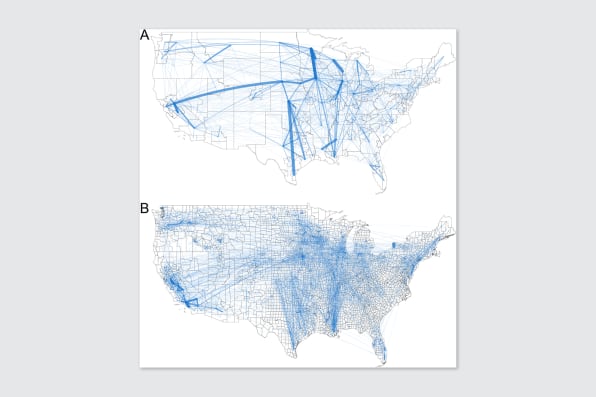
Our map is a comprehensive snapshot of all food flows between counties in the U.S.—grains, fruits and vegetables, animal feed, and processed food items.
To build the map, we brought together information from eight databases, including the Freight Analysis Framework from Oak Ridge National Laboratory, which tracks where items are shipped around the country, and Port Trade data from the U.S. Census Bureau, which shows the international ports through which goods are traded.
We also released this information in a publicly available database.
This map shows how food flows between counties in the U.S. Each line represents the transportation of all food commodities, along transit routes, such as roads or railways. [Image: Environmental Research Letters (2019)]
What does this map reveal?

1. WHERE YOUR FOOD COMES FROM

Now, residents in each county can see how they are connected to all other counties in the country via food transfers. Overall, there are 9.5 million links between counties on our map. 
All Americans, from urban to rural are connected through the food system. Consumers all rely on distant producers, agricultural processing plants, food storage like grain silos and grocery stores, and food transportation systems.
For example, the map shows how a shipment of corn starts at a farm in Illinois, travels to a grain elevator in Iowa before heading to a feedlot in Kansas, and then travels in animal products being sent to grocery stores in Chicago.

2. WHERE THE FOOD HUBS ARE

At over 17 million tons of food, Los Angeles County received more food than any other county in 2012, our study year. It shipped out even more: 22 million tons.
California’s Fresno County and Stanislaus County are the next largest, respectively. In fact, many of the counties that shipped and received the most food were located in California. This is due to the several large urban centers, such as Los Angeles and San Francisco, as well as the productive Central Valley in California.
We also looked for the core counties—the places that are most central to the overall structure of the food supply network. A disruption to any of these counties may have ripple effects for the food supply chain of the entire country.
We did this by looking for counties with the largest number of connections to others, as well as those that score highly in a factor called “betweenness centrality,” a measurement of the places with the largest fraction of the shortest paths.
San Bernardino County led the list, followed again by a number of other California transit hubs. Also on the list are Maricopa County, Arizona; Shelby County, Tennessee; and Harris County, Texas.
However, our estimates are for 2012, an extreme drought year in the Cornbelt. So, in another year, the network may look different. It’s possible that counties within the Cornbelt would show up as more critical in non-drought years. This is something that we hope to dig into in future work.

3. HOW FOOD TRAVELS FROM PLACE TO PLACE

We also looked at how much food is transported between one county and another.
Many of the largest food transport links were within California. This indicates that there is a lot of internal food movement within the state.
One of the largest links is from Niagara County to Erie County in New York. That’s due to the flow of food through an important international overland port with Canada.
Some of the other largest links were inside the counties themselves. This is because of moving food items around for manufacturing within a county—for example, milk gets off a truck at a large depot and is then shipped to a yogurt facility, then the yogurt is moved to a grocery distribution warehouse, all within the same county.
The food supply chain relies on a complex web of interconnected infrastructure. For example, a lot of grain produced throughout the Midwest is transported to the Port of New Orleans for export. This primarily occurs via the waterways of the Ohio and Mississippi Rivers.
The infrastructure along these waterways—such as locks 52 and 53—are critical, but have not been overhauled since their construction in 1929. They represent a serious bottleneck, slowing down innumerable supply chains nationwide, including that of grain. If they were to fail entirely, then commodity transport and supply chains would be completely disrupted.
Railroads are also important for moving grain. Fresh produce, on the other hand, is often moved around the country by refrigerated truck. This is due to the need to keep fresh fruits and vegetables—relatively high value agricultural products—cool until they reach the consumer. In future work, we hope to evaluate the specific infrastructure that is critical to the U.S. food supply chain.

Megan Konar is assistant professor of civil and environmental engineering at University of Illinois at Urbana-Champaign. This post originally appeared on The Conversation.

Monday, September 30, 2019

the passing of Joe Wilson, American Hero by Dan Rather


Dan Rather
30 Sept 2019
Please indulge me a personal memory:
News of the passing of Joe Wilson brought obituary tributes and flashbacks to a different time, particularly his important role in the national drama around the lead up to and execution of the second Iraq War. But for me, the headlines of his death transported me a decade earlier, although the stage was still Iraq.
The United States was on the brink of its first war with Saddam Hussein and a CBS reporting team and I were some of the few westerners in Baghdad. Joe Wilson, at the time already a seasoned diplomat, had been left in charge of a skeletal team at the U.S. Embassy. The mood in the Iraqi capital was tense and there was word that Hussein was going to round up westerners to act as human shields in advance of an anticipated U.S. aerial assault.
Wilson was as tough and as savvy as they got and was handling the final drawdown of American foreign service members with steel-eyed precision. But he also saw the bigger picture

He told me "You and the rest of your co-workers should leave as well Dan, but I know you won't." So he made a remarkable arrangement. He left the phone lines open at the Embassy and allowed us to stay, even after he had pulled out, thinking, correctly, that it would be extremely provocative for the Iraqi forces to storm what was in essence U.S. soil. It was an act I will never forget, demonstrating a deep respect for his role and that of the press.        


I soon had to leave as well to get back to New York to anchor, and the wheel of historical fortune continued to turn. Much has transpired since those days, but it is a moment and a man I will never forget.

Wednesday, September 11, 2019

SUDDEN STRATOSPHERIC WARMING: it's coming your way !

Occupy The Hollers

The Arctic is on fire. Now, Antarctica is suddenly experiencing a heatwave. And that means a looming rainfall apocalypse for Australia.
According to a recent report by senior researchers from the Australian Bureau of Meteorology, we're in for higher than normal spring temperatures. And less rain.
It's all because of record warm temperatures in the air swirling above Antarctica.
It's producing a domino effect.
The stratospheric "polar vortex" has been disrupted. It could even reverse direction.
It's pushing stormy Southern Ocean wind streams over Tasmania, New Zealand's South Island and South America's Patagonia. This is away from its regular route over the Australian mainland.
And that means NSW and southern Queensland - already in parts devastated by bushfires so early in the season - are set to face worsening conditions and an even more catastrophic bushfire season
SUDDEN STRATOSPHERIC WARMING
 Antarctica is suddenly experiencing a heatwave.
 producing a domino effect.
"The warming began in the last week of August when temperatures in the stratosphere high above the South Pole began rapidly heating," the article published in The Conversation reads. Four senior Bureau of Meteorology forecasters compiled it.
"Thanks to improvements in modelling and the Bureau's new supercomputer, these types of events can be forecast better than ever before."
It foresees a looming stronger-than-usual melt of sea ice.
It foresees a shift in the typical wind temperatures and patterns coming off the Antarctic continent.
"In the coming weeks the warming is forecast to intensify, and its effects will extend downward to earth's surface, affecting much of eastern Australia over the coming months," the forecasters warn.
It is likely to be the most severe Antarctic warming event on record.
The previous highest Antarctic air temperatures were in September 2002. These resulted in Australia's fourth driest winter on record, with spring-autumn mean-maximum temperatures the highest "by considerable margins".
This year is shaping up to be worse than 2002.
This year has been unprecedented in the northern hemisphere. Wildfires have swept through the Arctic, burning large swathes of Canada, Norway, Sweden and Siberian Russia.
These are regions packed full of fuel - from dense forests through to ancient peat bogs.
Usually, it doesn't burn because it's frozen or wet.
But year after year of warming temperatures have dried out growing patches.
"The north is a big tinderbox, but it's been limited from burning by the climate," Merritt Turetsky at the University of Guelph in Canada told New Scientist. "If you remove those climatic constraints, all those fuels are ready to go."
And it's adding to a warming feedback loop. Fires are killing the vegetation. That exposes the permafrost below to the sun's heat. And that releases the carbon dioxide and methane within.
Both gases then serve to trap even more heat in the atmosphere, further accelerating the feedback loop.
Antarctica has no such forests. But the extent of its sea ice determines the temperature and course of ocean currents and winds. As the ice retreats, those long-establish flows weaken and shift.
"It is abundantly clear that climate disruption is happening now and everywhere," UN Secretary-General Antonio Guterres warned earlier this month. "Every week brings us news of more climate-related devastation. And climate impacts are only going to increase in severity and frequency."
POLAR FALLOUT
The Antarctic is the engine room of the southern hemisphere's climate.
Every winter, westerly winds begin to swirl at speeds of up to 200km/h high above the South Pole.
The mechanics are relatively simple.
It's cold above the pole, which is experiencing months of darkness. But the Southern Ocean is still being warmed by the sun.
And, as the sun begins its southward march with the onset of spring, the polar vortex is gradually weakened.
"However, in some years this breakdown can happen faster than usual," the meteorologists write.
In such instances, unusually hot air intrudes over Antarctica - disrupting the temperature mix producing the high-speed westerly winds.
"Very rarely, if the waves are strong enough they can rapidly break down the polar vortex, actually reversing the direction of the winds so they become easterly," the article continues.
The only time this has been seen to happen was September 2002.
It's on the brink of happening again.
"Impacts from this stratospheric warming are likely to reach earth's surface in the next month and possibly extend through to January," the meteorologists warn.
And that means even less rainfall for much of southern and Central Australia.
With it will come clearer skies and higher temperatures.
"Past stratospheric warming events and associated wind changes have had their strongest effects in NSW and southern Queensland, where springtime temperatures increased, rainfall decreased, and heatwaves and fire risk rose," they say.
This compounds an already disastrous winter for New South Wales and much of Queensland. There, soil moisture levels actually decreased over what should have been their wet season.
So spring - and summer - will be starting from an already devastatingly dry low.


Tuesday, September 10, 2019

chemical food dyes : motor oil and gasoline

43% of Products Marketed to Kids are Artificially Dyed, Study Finds

Red 40, Yellow 5, and Other Dyes Cause Hyperactivity and Other Behavioral Problems in Children


Today, chemical food dyes are commonly added to foods to improve their color and give them a vibrant appearance. These chemical food dyes are made from petroleum – the yellow liquid that is mined from the earth to produce motor oil and gasoline.
Moreover, there are concerns that they could have other potentially harmful side effects too. According to studies, artificial food dyes have the potential to cause the following effects:
At this moment, the Food and Drug Organisation (FDA) is not concerned about these petroleum products used in American food, but many of them are outlawed in other countries around the world because they pose serious health risks. As a matter of fact, there are studies that have linked artificial food dyes to allergies, hyperactivity, and even cancer, particularly in children.
Hyperactivity
  • Cancer
  • Allergic reactions
  • Obesity
  • Asthma
  • Diabetes
  • Chromosomal damage
  • Hypoglycemia
  • Organ damage
  • Birth defects
Furthermore, chemical food dyes also contain unknown and unexpected impurities. As a matter of fact, these impurities are so toxic that the European Union and the British government have ended the use of dyes in food throughout Europe since 2009.
In this article, we’re going to reveal some of the scientific research for the potential danger of chemical food dyes. Moreover, at the end of the article, we will reveal which popular products contain chemical food dyes.
Most common food dyes used today
The most common chemical-based food dyes are Yellow 5, Yellow 6, and Red 40. However, popular chemical dyes for food also include Blue 1, Blue 2, and Red 3. Artificial food dyes are combined with food in order to create the right color for food and make it more attractive.
The U.S. Food and Drug Administration (FDA) states that artificial food colors must be tested and certified before being used in foods and drinks. Although artificial food dyes used in food processing go through rigorous testing for toxicity by the FDA, some research has shown that artificial food dyes may contain cancer-causing chemicals including benzidine, 4-aminobiphenyl, and 4-aminoazobenzene.
Another concern about the dangers of artificial food dyes is their impact on children. For instance, children tend to eat more artificially colored beverages and foods than adults. Plus, their smaller body weight indicates that children proportionally utilize more food dyes than adults. Moreover, children’s bodies are more sensitive to carcinogens than adults.
Moreover, there may be dangers when more food coloring chemicals in food are mixed together. For instance, one study discovered that a combination of Red 40, Yellow 4, Yellow 5, Red 2, and other food dyes can negatively affect the central nervous system. Unfortunately, there are not many studies that have been carried out on the synergizing effect of combining artificial food dyes.
There are also many studies that have shown the link between artificial food dyes and allergies, cancer, and attention deficit hyperactive disorder (ADHD). Some studies found that artificial food dyes could be contaminated with cancer-causing chemicals.
Approximately 90 percent of the dyes used in foods are Red 40, Yellow 5, and Yellow 6. Even there are cases when fresh oranges are dipped in dyes to brighten them and provide a uniform color.
Artificial food dyes dangers
Red 40: This is one of the most common artificial food dyes used in foods processing. According to studies, Red 40 can contain p-Cresidine which is classified as a potential carcinogen. It also has been proven to cause immune-system tumors in animals and allergic and hyperactive reactions in children.
Red 3: According to studies, the food dye Red 3 may affect the function of the thyroid gland and increase the risk of breast and thyroid cancer. In another study, Red 3 was shown to have estrogen-like activity in the body, which also could be a risk factor for the development of breast cancer.
Yellow 5: According to studies, Yellow 5 can be contaminated with the carcinogen benzidine. This food dye also has been linked to organ damage and affect the gastric mucosa in experimental animals.
Yellow 6: Tests showed that Yellow 6 may be contaminated with benzidine and 4-aminobiphenyl. Both substances have been shown to increase the risk of testicular and adrenal tumors. One study published in the Journal Toxicology found that Yellow 6 has an estrogen-like effect in the body, which has been shown to increase the risk of breast cancer and biliary cirrhosis.
Blue 1: This artificial food dye can affect how the body reacts to inflammation and the stability of cell development. According to one 2016 study, Blue 1 has a potential risk in the development of cancer and affect the nervous system.
Blue 2: This food additive is commonly found in colored sodas, candies, and other foods. Some studies even indicate that Blue 2 increases breast tumors and brain gliomas in rats.
A list of popular children’s foods you’ll want to avoid
1. M&M’s: These are fun chocolate candies that melt in your mouth and not in your hands. These manufacturers utilize Red 40, Yellow 6, Yellow 5, and Blue 2, which are known to cause brain and bladder tumors. Moreover, they contain Blue 2, which inhibit the development of nerve cells. Since all of these artificial colors are made from petroleum, they also can cause hyperactivity, allergic reactions, and cancer.
2. Pop tarts: These toaster pastries contain corn syrup, high fructose corn syrup, dextrose and sugar within the first 7 ingredients. These sugary products have all been associated with childhood diabetes, liver problems. and sugar addiction. Pop tarts also contain TBHQ, which comes from petroleum and damages human DNA and causes cellular dysfunction.
3. Fruit snacks: Many fruit-based snacks such as jam-filled cereal bars that market themselves as healthy options, are filled with food coloring to make them more appealing. Red 3 (also known as E127) is commonly used, which is worrisome since it has been banned from cosmetic products for causing thyroid tumors.
4. Cheetos: Cheetos are colored with Yellow 6, which is derived from petroleum. They also contain artificial flavorings such as methyl benzoate and ethyl methylphenidate. These chemicals have been shown to cause intestinal distress, gastritis, and addiction-like dependence in children and adults.
5. Teddy grams: Teddy grams are laced with TBHQ, which has been shown to cause nausea, vomiting, delirium, collapse, and ringing in the ears. Moreover, it has been shown to cause stomach cancer, DNA damage, and damage to human lungs and umbilical cells. In children, it can cause restlessness, anxiety, and enhance the symptoms of ADHD.
Think your friends would be interested? Share this story!
Source:
You Might Also Like

Artificial Food Dyes : DANGER


Approximately 90 percent of the dyes used in foods are Red 40, Yellow 5, and Yellow 6. Even there are cases when fresh oranges are dipped in dyes to brighten them and provide a uniform color.
Red 40: This is one of the most common artificial food dyes used in foods processing. According to studies, Red 40 can contain p-Cresidine which is classified as a potential carcinogen. It also has been proven to cause immune-system tumors in animals and allergic and hyperactive reactions in children.
Red 3: According to studies, the food dye Red 3 may affect the function of the thyroid gland and increase the risk of breast and thyroid cancer. In another study, Red 3 was shown to have estrogen-like activity in the body, which also could be a risk factor for the development of breast cancer.
Yellow 5: According to studies, Yellow 5 can be contaminated with the carcinogen benzidine. This food dye also has been linked to organ damage and affect the gastric mucosa in experimental animals.
Yellow 6: Tests showed that Yellow 6 may be contaminated with benzidine and 4-aminobiphenyl. Both substances have been shown to increase the risk of testicular and adrenal tumors. One study published in the Journal Toxicology found that Yellow 6 has an estrogen-like effect in the body, which has been shown to increase the risk of breast cancer and biliary cirrhosis.
Blue 1: This artificial food dye can affect how the body reacts to inflammation and the stability of cell development. According to one 2016 study, Blue 1 has a potential risk in the development of cancer and affect the nervous system.


Blue 2: This food additive is commonly found in colored sodas, candies, and other foods. Some studies even indicate that Blue 2 increases breast tumors and brain gliomas in rats.

Monday, September 2, 2019

Labor Day 2019 by Dan Rather


This Labor Day morning, I pause. The news that swirls is of tragedy and destruction. A horrific hurricane devastating the Bahamas and taking aim on potentially hundreds of miles of coastline along the Southeastern United States. A historically massive footprint of wind, rain, and storm surge, What horrors await?
Another mass shooting, lives ripped from families and friends with a cycle of violence that only seems to intensify. Where will be the next dateline of carnage? And now, a massive boat fire off the coast of California with many feared dead.
If we look beneath the breaking news, we know there is pain everywhere, in wartorn countries, in those being separated along our border, in those facing hate and intolerance, sickness and poverty. We know that larger forces of suffering march onward, like the opioid epidemic and the crisis of our climate, which we see reflected in not only models for the future but in our present.
Add to that, a president who seems intent on exacerbating or even creating challenges rather than solving them. The bleakness of this administration and those who enable it fills newspapers and newscasts daily, not to mention the unsettling conversations of citizens.
I have spent several days with close family, on a weekend of conversation, trips to the movie theater, shared meals. It has been calming and contemplative, but I know that millions feel no safety or joy in the present. How do we not lose hope?
I take some solace in the movement this day commemorates. There was a time in this nation when labor was exploited virtually without recourse. When children toiled and died in dangerous conditions, when people could be fired for no reason, when workdays and workweeks stretched on with no pause, when wages were not subject to any legal oversight. I know that we still have a long way to go and the economic system of our times comes with many challenges and injustices. But what I remember was that what changed the course of our nation then, as it can now, is the collective movement of people coming together, bonded by a common story of work and a search for dignity.

The labor movement and unions have made mistakes to go along with their victories. We can debate what form of labor rights our current system should take. But we should recognize that we are stronger when we are confronting our struggles together.
We are in a moment of reckoning. We are at a time when we are being told that we are different, from our fellow Americans and from others in the world. We are at a moment where the size of the hurdles is being used to demoralize rather than inspire. The fight for basic labor rights did not seem to be a foregone conclusion in the America of my youth, much like the struggle for civil rights. And we are seeing now that those battles continue. But the fact that we celebrate a Labor Day is a sign that there can be triumphs in the future even if the present seems bleak.