Showing posts with label slaves. Show all posts

Wednesday, August 10, 2022

The New Histories (photo edit)

 Scholars pursue sweeping new interpretations of the human past.

Harvard Magazine

NOVEMBER-DECEMBER 2014

IN MAY 1968, the university’s students wanted to change the world. Left-thinking ideologies like Maoism and socialism were in their minds, and “Vietnam” was on their lips. They went on strike, skipping classes and exams. They rioted and clashed with police. One student was killed, 900 arrested.

If this sounds like a scene from Kent State, where student demonstrators were killed two years later, that is because the May 1968 unrest at the University of Dakar in Senegal was part of the same general mood around the world that moved students to protest, says Omar Gueye, professor of history at Cheikh Anta Diop University in Dakar. Gueye spent six months at Harvard during the 2013-14 academic year as a postdoctoral fellow at the Weatherhead Initiative on Global History (WIGH), a program premised on the belief that events like these—not unlike the seemingly contagious uprisings of the Arab Spring—can be fully understood only in a global context. As elsewhere during the student protests of the late 1960s, local factors played a role in Dakar: government cuts in scholarship funding precipitated the strike. But student anger tapped a deeper sense of injustice as well: although French colonial rule had ended in 1960, the university was still French, Gueye explains, and the French military was still stationed in Dakar. “Vietnam”—another former French colony—therefore had a specific resonance among Senegalese students, who felt a sense of brotherhood with the Vietnamese.


HISTORIANS increasingly recognize that trying to understand the past solely within the confines of national boundaries misses much of the story. Perhaps the integration of today’s world has fostered a renewed appreciation for global connections in the past. Historians now see that the same patterns—colonialism, or the rise of small elites controlling vast resources—emerge across cultures worldwide through time, and they are trying to explain why. “If there is one big meta-trend within history, it is this turn toward the global,” says Bell professor of history Sven Beckert, who co-directs WIGH. “History looks very different if you don’t take a particular nation-state as the starting point of all your investigations.”

The rise of a global perspective is one of several trends that are changing the way history is studied and understood. The increasing use of science to illuminate the past is another. Goelet professor of history Michael McCormick leads the University’s Initiative for the Science of the Human Past, which has engaged a range of collaborators: from geneticists and chemists elucidating patterns of migration using DNA and isotopes, to climate and computer scientists using ice cores and Christian texts to parse the rise and fall of civilizations. In the Joint Center for History and Economics, Knowles professor of history Emma Rothschild has, as director, revitalized this third realm of historical research (which dates to the 1890s in the United States and Britain). Scholars there embrace new quantitative methods such as network analysis to enhance historical inquiry (see “Examining Economic Webs,” page 56); by undertaking collaborative projects—such as studying the history of energy—they are contributing freshly relevant understanding to some of today’s most pressing problems.

These three projects differ significantly, notes Adams University Professor emeritus Bernard Bailyn, “and they have very little directly to do with each other. But together, they create enough intellectual energy in the history department to light a midsized city.”


Fractal History

“IN THIS CONTEMPORARY MOMENT in which the world is becoming ever more globally interconnected,” says Beckert, “historians can’t help but observe that a global perspective might also be a useful way to understand the human past. We have spent the past hundred years looking at history within a nation-state framework, and there are limitations to that.” By looking beyond these boundaries, he points out, “an entirely new history opens up.” His WIGH co-director, Saltonstall professor of history Charles Maier, notes that global history allows scholars to consider common challenges facing all of humanity, such as climate change or disease. “Or you can consider the impact that societies have on each other, sometimes referred to as ‘entangled history’ ”—why, for example, students around the world rose up in the 1960s in protest against social norms. A global perspective also makes possible the study of events such as migrations from one nation or region to another. Says Maier, “It opens you up to all kinds of questions.”

The Weatherhead initiative, collaborative to its core, attracts scholars from around the world. Faculty members, undergraduate and graduate students, and post-doctoral fellows meet weekly to discuss their research projects and to seek insights from their colleagues, often expert in the same fields, who work in the context of other countries. This past spring, Maier sought comment on a draft chapter of his forthcoming book on changing concepts of territoriality. He heard from scholars rooted in a variety of countries and eras, ranging from an undergraduate to a visiting postdoctoral fellow who studies Franciscan monks, members of a mendicant order of the Catholic church with an abstemious relationship to both property and territory, who established missions worldwide in the Middle Ages (see “Alternative Histories,” below).

The idea, says Beckert, is not just to write global history at Harvard, but to seek alternative perspectives from scholars in other parts of the world, especially voices of scholars from the global South, who often have pioneered the field without being heard in the West: “This relates to the internationalization of the University. We bring a dedication to the study of other parts of the world, but we are also very eager to start a global conversation on that global history.” To that end, WIGH both brings foreign scholars to Cambridge, and has established a network of research and teaching nuclei on four continents, with collaborations in China, India, the Netherlands, Senegal, and Brazil.

Because global history by its nature is inclusive, and actively seeks multiple points of view, says Maier, it has evolved in the spirit of the working-class histories championed by British historian E.P. Thompson in the 1960s. In that sense, “there is a moral component” to it, he feels. “It can’t be only about empires. It’s not that spatially you miss much,” he explains, “but empires are the stories of elites.” In global history, “voices cannot be hierarchized. You have to give the global South its voice,” for example. “Each history has to be written from its own perspective.”

One of the large questions that global history seeks to answer is why social structures that maintain the power of elite minorities are perpetuated. Maier notes “the fractal nature of social organization, as patterns repeat themselves at different levels of society, and across cultures. How do they carry on so strongly,” he wonders, “when they benefit such a small group of people?”


The “Great Divergence”

BECKERT HIMSELF has sought to answer this big question through a decade-long study of cotton—the commodity that started the Industrial Revolution and, he argues, shaped the present global capitalist system: glorious at its best, but at its worst, a “race to the bottom” that seeks the cheapest labor and materials. Beckert’s work has culminated in Empire of Cotton: A Global History (Knopf), to be published in December. As he writes in the introduction:

Particularly vexing is the question of why, after many millennia of slow economic growth, a few strands of humanity in the late eighteenth century suddenly got much richer. Scholars now refer to these few decades as the “great divergence”—the beginning of the vast divides that still structure today’s world, the divide between those countries that industrialized and those that did not, between colonizers and colonized, between the global North and the global South.

Taking a global perspective sheds fresh light on capitalism’s reliance on transoceanic connections, such as the simultaneous rise of industrial wage labor in Europe and slave labor in America. “We have hundreds of books on the Industrial Revolution in England,” says Beckert, “and these books focus, as they should, mostly on the expansion of cotton manufacturing, because that’s the beginning of the Industrial Revolution. And then we have hundreds of books on the expansion of slave agriculture in the United States. But these stories are, as I show, very tightly linked to one another because with the growth of cotton manufacturing in Europe, huge needs for cotton emerged there. And since cotton does not grow on the continent of Europe, but it grows very well in places like…the United States, there is a huge expansion of cotton agriculture there, almost all of it based on slave labor. Slavery is central to industrial capitalism as it emerges in the nineteenth-century.”

Beckert tells how in 1785 British customs agents in Liverpool seized bags of cotton from an American ship when it sought to deliver the cargo. They didn’t believe the cotton came from the United States because at that time the plant was grown almost exclusively in the Ottoman Empire, the West Indies, Brazil, or India. “That the United States would ever produce significant amounts of cotton…seemed preposterous,” he writes. It was, he concludes, a “spectacular misjudgment,” given the ensuing transformation of the American South from producing “tobacco, rice, indigo, and some sugar” to producing cotton. And it upends the American sense of independence and self-determination: European industrialists and financiers were key to this transformation of the American South.

Taking a global view allows Beckert to explore why, for example, beginning around 1800, more cotton wasn’t cultivated in India, where it also grows well. At issue was not just the fact that slave-labor exploitation in the American South made production there cheaper. “Even though the British wanted to get cotton from India,” he explains, “they more or less failed in that project until the later part of the nineteenth century because of the difficulty of recasting colonial India’s political, social, and economic structures.”

child picking cotton in Arkansas

Then the American Civil War, and the end of slavery, triggered the world’s first raw materials crisis. “It would be as if, suddenly, no oil came from the Middle East,” Beckert says. European textile manufacturers were forced to find new sources of raw cotton. Focusing their attention on Egypt, India, and Brazil, they eventually succeeded in transforming agriculture in those parts of the world to extract more cotton.

Global history is “the kind of idea that, once you have it, is impossible to go back from,” Beckert continues. “You can’t. It’s going to be with you forever because it’s just a different way of seeing history.” While it opens new questions, it “also opens up totally new understandings of particular historical problems such as the problem of slavery. You understand, on a global scale, that the global problem, from the perspective of European colonialists and European entrepreneurs, is really how to transform the countryside. The resulting transformation takes different forms in different parts of the world, but sometimes it’s also quite similar. After the Civil War, for example, sharecropping becomes dominant in the United States, but it’s also important in Egypt, Mexico, Brazil, and other parts of the world. People in these places learn from one another. They observe one another.”

Capitalism can make strange bedfellows. Beckert relates how in 1898, the German ambassador to the United States approached Booker T. Washington, asking him to send students and professors—the sons and grandsons of slaves—from Tuskegee to Germany and then on to the West African colony of Togo to transform cotton agriculture there: “an amazing story of African Americans advising deeply racist German colonialists in Togo about how to make local peasants produce cotton for world markets.”

Beckert’s work played an important role in attracting graduate student Joan Chaker to Harvard from Lebanon. She’d written her master’s thesis years ago about the tobacco market in the Ottoman Empire, but quickly came to understand that she could not comprehend that history without looking beyond Turkey, to European financiers and their interests. After a stint as a banker in Amsterdam, Chaker resolved to return to academia. When she discovered Beckert’s work on cotton, it was “enlightening” she recalls, “because it explained a lot of history in the Ottoman tobacco market.” Like cotton, tobacco is a global commodity, and the American civil war allowed Turkish tobacco to acquire an important share of the global market. “I saw that I could transpose ideas from his framework to mine,” she says.

“I think students are catching on to the excitement,” says Beckert, “and to the fact that we have this institution now where they can connect, meet each other, other faculty members, visitors, and postdoctoral fellows who have taken a great role in helping them with their research papers.” Training the rising generation of historians in this way “makes it possible for them to embark upon projects that would likely have seemed too ambitious for a student even a few years ago. And they have the opportunity to become part of a global scholarly community from their first year in graduate school.”

In a 2009 essay, Maier noted that teaching global history to undergraduates has been one of the most difficult challenges of his career “because of the sheer volume of new information students confront.” Still, he wrote, “introducing global history strikes me as the most imperative challenge for historical teaching today,” given “the readjustment of American power and wealth, the migrations of new citizens, the clamorous challenges of inequality and environmental fragility.” The challenge of ensuring that undergraduates are familiar with basic historical timelines and factual details that undergird more detailed studies will become more acute if a course in global history is developed in the College. But there is enthusiasm for attempting this, says Beckert, even among faculty members not presently involved in the initiative.


Alternative Histories

GLOBAL HISTORY is not just economic history, Beckert emphasizes. Julia McClure, a WIGH postdoctoral fellow during the 2013-2014 academic year, studies a kind of global network radically different from his capitalist empire of cotton. Her ambitious goal is to understand how knowledge of the world is structured and formed. She is pursuing her subject by studying Franciscan missionaries, who traveled the globe from southern Europe in the Middle Ages and early modern era, quietly establishing a network of knowledge about its farthest reaches.

Franciscans arrived in the Far East years before Marco Polo did in the thirteenth century. They traveled to Scandinavia and North Africa. They played a key role in shaping Spanish colonialism in the Americas. Everywhere a new land was brought into the European orbit, it seems, Franciscans were there first. Yet the primacy of their explorations, though recorded in detail, is virtually unknown. In McClure’s view, this underscores the ways in which “history itself has been produced and used…to further nationalistic goals.” Whether to exert power or stake colonial claims, nations want to show that they discovered certain regions first. The Franciscans, “without that power agenda, have been left out” of the history books. Although they recorded what they found, few non-Franciscans have read their records. McClure recently obtained a copy of a letter, found in a Franciscan monastery in Bavaria, that was written in 1500 from the island of Hispaniola, where colonization initiated by Christopher Columbus and his son Diego ultimately decimated the native population. The letter “reveals much about the first years of the encounter history,” she says, but it is little known because no one has looked in depth at the Franciscan chronicle of what happened there.


Her work “puts the Middle Ages into a global context,” McClure says. “People think global connectivity begins in the nineteenth century with telephone cables, but it exists in the Middle Ages, and one way to represent that is through the movements of the Franciscan order.” The larger importance of that revelation is that “there is an alternative account of global history.” She aspires to use the Franciscan version of global history to pioneer an approach and perspective that lets students and others see traditional, mainstream history as a narrative constructed with intention—whether good or bad: a narrative that might be told in other ways.


Reaching Beyond the Written Record

GLOBAL HISTORY might be said to embody a simultaneous expansion of perspective and geographical scope. The science of the human past adds a third dimension: time. “Science is dissolving the boundary between history and prehistory,” explains Michael McCormick. “Historians have been confined until now to texts. Suddenly, we can chart the movements of groups of early humans in Africa” and beyond, he marvels, “and we see the human past as a much longer and deeper story.”

“It is so exciting to be an historian today,” McCormick continues. “History is exploding and transforming as the material past becomes an integral part of the historical record. We can no longer be satisfied with texts, because we are just as likely to learn something from a pot or from the lipids preserved in the fabric of the pot that tell us whether they were cooking cabbage or chicken for dinner in the seventh century A.D. when the Anglo-Saxons were taking over England (see “Who Killed the Men of England,” July-August 2009, page 31). Using DNA, “we can map human migrations or identify the genetic groups present, for example, in a burial ground from the Black Death [bubonic plague] in London, or from an imperial Roman estate in southern Italy,” McCormick says. “These are just the beginnings of the application of genetics and isotope studies to migration and questions of diet.”

A further implication of this approach, he points out, is that historical inquiry is “no longer limited to the most powerful people, who were usually the only people to make it into writing. We can see the history of individuals who had no surviving voice in the record coming back almost to life.”

During the 2013-14 academic year, McCormick co-taught History 1940, “The Science of the Human Past” (cross-listed as Human Evolutionary Biology 1940) with Clay professor of scientific archaeology Noreen Tuross. One student in the class, Marie Keil ’14, who had originally planned to become a chemist in the materials industry, changed her mind after hearing a guest lecture by Fenella France (who has used multispectral imaging to decipher erased texts in Thomas Jefferson’s draft of the Declaration of Independence). Keil spent the ensuing summer working with France at the Library of Congress in chemical analysis of ancient inks, and is now pursuing a master’s in archaeological chemistry at Oxford. Another student, Brendan Maione-Downing ’13, worked for a year after graduating as managing editor of the Digital Atlas for Roman and Medieval Civilization, a free online atlas of the ancient world created by McCormick and his students that maps everything from Roman cities to ancient shipwrecks in the Mediterranean. Maione-Downing has gone on to a career in GIS (geographic information systems). McCormick marvels, “Brendan and Marie discovered their life’s work through one new course in the science of the human past.”

McCormick’s own life work is the fall of the Roman empire and origins of Europe. A longstanding question, now poised to be answered through techniques that Tuross has pioneered, concerns the origins and production of silk within the empire. As cotton would link the industrializing world a thousand years later, silk linked the ancient, precapitalist world. The so-called Silk Road, 4,000 miles long, consisted of a number of trade routes that connected China to the Mediterranean, and was essential to the economic development of these and intervening empires in India and Persia. “Luxury industries,” says McCormick (citing Werner Sombart, an early-twentieth-century historian of capitalism), “are the places in which capital first came together to do amazing things and multiply wealth. It was an early generator.” Because the fabric was one of the first global commodities, “volumes and volumes have been written on where a particular piece of silk comes from,” McCormick explains. “It’s really important for art history, for culture, for the economy.”

Because silk is light and easily transported, it “was worth many times its weight in gold,” McCormick continues. “If you’re carrying something from China to Italy on camelback and making money on it, it’s extremely valuable.” Pliny the Elder writes about the vast sums that Rome is sending to China and India in exchange for spices and silks, “but we don’t know where the silk that is being used in the Roman empire is coming from.” Very little is known about the spread of silk-making technology in the ancient world, or the history of the trade, because the many bits of silk fabric retrieved in archaeological digs or held in museums are hard to date and localize: on a trip to the textiles section at Boston’s Museum of Fine Arts, McCormick says, the class met with curators and “looked at the weave through a microscope and talked about established methods people have used” to identify the fragments’ origins.

Silk production is especially fascinating because silkworms cannot live without human care. Released into the wild, they die. In the sixth century a.d., the emperor Justinian reportedly sent industrial spies to the “Silk Land” (according to the Greek text) in order to bring the secret of silk production back to his empire. “They hollowed out their walking sticks and filled them with silkworm eggs,” McCormick relates. “And then they started silk production inside the Roman empire—according to two detailed written records in the original Greek sources.”

But some historians claim the empire was producing silk much earlier. This important historical question will likely be settled soon because Tuross, a chemist, has developed a technique for pinpointing the origins of ancient shreds of silk fabric. She is an expert in isotope analysis. By examining physical remains, for example, she can discover what food individuals ate during their lifetimes, the places where they grew up, and whether their lives ended somewhere else. At a symposium on the science of the human past in the fall of 2013, she described how the Arctic voyages of seventeenth-century Dutch whalers become etched in isotopic signatures in their teeth. Changes in people’s diet—even in the water they drink—can reveal where they have lived or traveled. Tuross earlier used such analysis to characterize the diet of Neanderthals (see “Who Killed the Men of England,” page 35), shattering myths about their putatively carnivorous tastes. “Now, using Noreen’s methods,” says McCormick, “we’ll be able to show whether silk was being cultivated inside the Roman empire before the sixth century. We’ll be able to see its introduction to Spain, to Sicily, to Italy, and ultimately to France. And we’ll be able to track the spread of the technology, after the Islamic conquest, throughout the Islamic world.” Scholars may find evidence of competition between China and India, or something wholly unexpected: McCormick tells how French researchers using the Louvre’s particle accelerator to analyze the origins of garnet jewelry from the Roman empire discovered interruptions in the trade of these red gemstones from India and Sri Lanka. Demand had remained high (the Romans eventually sought and found new sources of supply), raising the question, “What happened in India, Sri Lanka, or along the way that interrupted this trade?”

The question is important because these economic exchanges, which show that even the ancient world was an interconnected place, underlie pivotal cultural exchanges: of art, design, and ideas that shaped the subsequent course of history.


The Global and the Local

THE INITIATIVE for the Science of the Human Past might be said to have launched important cultural exchanges of its own, by putting historians in contact with scientists. In 2012, McCormick and Peter Huybers, professor of earth and planetary sciences and of environmental science and engineering, with other colleagues, published the first general survey of climate change within the Roman Empire, from 100 b.c. to a.d. 800. They showed that climate crises were closely linked to the expansion and contraction of the agriculturally dependent empire. They are now working on a broader project that combines climate proxies such as tree rings, speleothems (mineral deposits found in caves), and ice-core analyses with the written record for five major climate crises spanning the years a.d. 536 to 1741 not only for Europe, but also for China and Japan. The collaboration is mutual, because the scientists will use existing written records—what Huybers has termed “the most powerful proxy record there is: a human being who was there who will tell us what happened”—to help calibrate their scientific methods.

The collaboration extends into computing and genetics as well. Welch professor of computer science Stuart Shieber, for example, has developed programs for analyzing texts. In one demonstration, he was able to identify in a few minutes all the biblical references in a written record—work that had taken a class of students a week to analyze. He is now working with McCormick to develop a method for dating published Latin biographies of Christian saints. “There are 14,000 of them,” explains McCormick. “Of these, 6,000 have been dated to within a period of 500 years or less. That means there are 8,000 texts that no one has even bothered to look at. If we could date just 10 percent of those, that would be 800 new texts for historians to work with”—in an area “we thought to be well-mapped.”

Meanwhile, at Harvard Medical School and the Broad Institute, professor of genetics David Reich and visiting scientist and research fellow Nicholas Patterson use genetics to trace early human migrations and conquests. With the initiative’s first postgraduate fellow, Sriram Sankararaman, they are working to understand the genetic variations contributed to modern humans by archaic hominins such as Neanderthals and Denisovans (see “Human Family Reunions,” July-August, page 7). Separately, they have explored the genetic origins of the peoples of the Indian subcontinent, showing a recent population admixture, and have elucidated the origins of Native Americans. McCormick is realistic about his own interest in whether genetics will be able to determine who, precisely, the barbarians were who sacked Rome. But in part because the genetic differences between the conquerors and the conquered may be too small to see, as he acknowledges, McCormick says Reich and Patterson are right to concentrate on the “gigantic” questions: “the out-of-Africa event, the peopling of Australasia, the origins of Indo-European languages and whether they are tied to population movements.”

McCormick never suspected that his own sphere of interest—the Roman empire—would extend beyond its ancient boundaries. But science has been for him a path to discovering a broader perspective that links to the work of other colleagues in the history department, a turn to the global and the quantitative in the study of history. “When I started out in graduate school,” he says happily, “I had no idea that what was going on in China could be of any interest to me. Wrong again!”

“Entangled history,” or the ways that societies affect each other, is one thing. Entangled historians are quite another. During the six months he spent on campus finishing his book on May 1968, Omar Gueye learned much from the global history program, other global-history fellows, and the books he found in Harvard’s library (“for some, I am almost sure I am the first person to see them”), as well as from other professors at the University: professor of history Lisa McGirr, for example, who lectures on “protest and politics” in American history, including the 1960s in the United States; and Prince Alwaleed Bin Talal professor of contemporary Islamic religion and society Ousmane Oumar Kane, who has studied religion among Senegalese immigrants in New York City.

These intellectual exchanges often prompt unexpected discoveries. One student from Taiwan was astonished to learn from Gueye that there were Taiwanese students studying in Dakar in 1968. And Gueye hopes there will be many more such productive exchanges to come, now that a global network of scholars has been formed. A conference on global conceptions of freedom—of particular interest to historians of slavery in Senegal and Brazil—may take place in Dakar in 2015. How did ideas of freedom emerge around the world? What do they have in common? How do they differ, and how do they inform each other? “The goal of this program is to open up dialogue and perspective,” Gueye says. In the past, “People talked about world history. But now we have a strong network of people who formally think about it together.”  

Tuesday, April 8, 2014

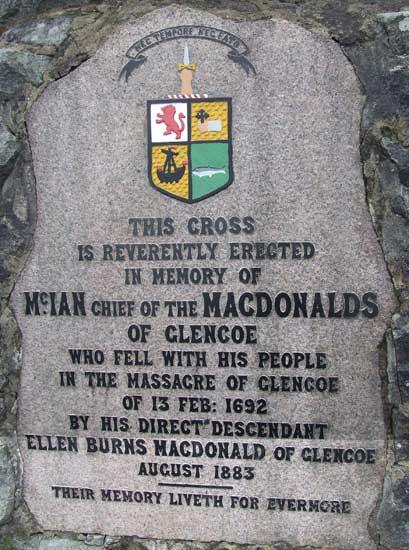
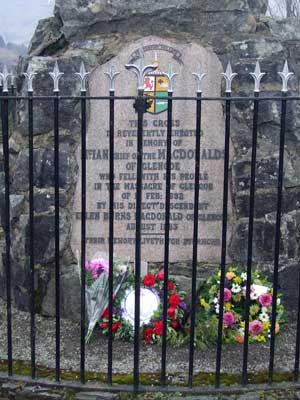
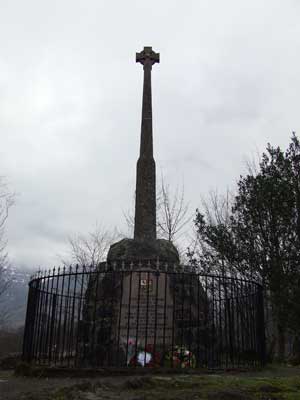
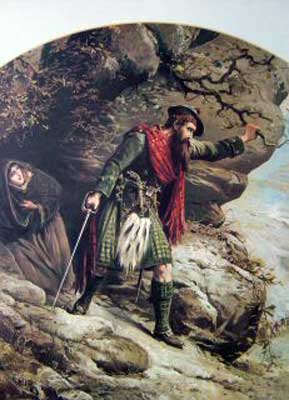
THE MASSACRE OF GLENCOE 1692


THE MASSACRE OF GLENCOE 1692
by Charlene McGowan
The Massacre of Glencoe has been written about, sung about and romanticized. It did, in fact happen pretty much as the song portrays.
 The independent chiefs had become over powerful, some say to the point of being barbaric.

They would execute members of the clan whom they felt deserved this extreme penalty, and, most irritating to their settled neighbours, they lived only for cattle raiding and plunder. Clans MacDonald and Campbell were two of the most notorious cattle reivers (thieves) and they mostly were stealing from each other.

 Towards the end of 1691, William III considered the best way to establish law and order would be to grant an amnesty and let bygones be bygones. However, a condition of this amnesty was that all the clan chieftains who had not previously done so must acknowledge allegiance by January 1 1692. For some reason, pride, or otherwise, MacDonald of Glencoe (MacIan) was one of the last to comply with the terms of the government.

On December 31, 1691, MacIan made his way to Fort William and presented himself to Colonel Hill, the governor, asking him to administer the required oath of allegiance.

The colonel declined saying that according to proclamation, the civil magistrate alone could administer the oath. MacIan pleaded with him as to the urgency of the matter and the fact that there was no magistrate he could reach before the expiration of the day. Hill persisted in asserting his power, but advised MacIan to proceed instantly to Inverary.
He provided him with a letter to Sir Colin Campbell of Ardinglass, sheriff of Argyleshire begging him to receive MacIan as "a lost sheep" and to administer the necessary oaths. Hill also gave him a letter of protection and an assurance that no proceedings should be instituted against him under the proclamation till he should have an opportunity of laying his case before the King of the privy council.

 MacIan left Fort William immediately and traveled through almost impassable mountains covered with snow. Campbell was absent when he got there and MacIan had to wait three days till his return, Sir Colin having been prevented from reaching Inverary sooner on account of the weather. Campbell, at first, declined to see MacIan as the time allowed for the proclamation had expired but MacIan threatened to protest against the sheriff should he refuse to act. Campbell yielded, administered the oath, and MacIan returned home believing himself free of danger.

At the beginning of February, a company of 120 men descended on Glencoe under the command of Captain Campbell of Glenlyon, who was related by marriage to MacIan. Under the pretext of friendship and to obtain suitable quarters where they could conveniently collect the arrears of "cess and hearth-money", a new tax law laid by Scottish parliament in 1690, they received a hearty welcome.

Glenlyon and his troops were entertained by MacIan and his people for over a week. On the 12th of February, the order of "fire and sword" (to put everyone to death and burn everything) was handed down to Arglye's regiment and they were ordered to proceed to Glencoe so as to reach the post by five o'clock the following morning. The instructions reached Glenlyon to "all upon the MacDonald's precisely at five o'clock the following morning and put all the sword under 70 years of age".

After dinner and a card game with the sons of the chieftain, Glenlyon wished them a goodnight and even accepted an invitation by MacIan to dine with him the following day. MacIan and his sons retired at their usual hour, but early in the morning, one of the sons hearing voices about his house, grew alarmed and, jumping out of bed, went to Glenlyon's quarters to ascertain the cause of the unusual bustle which had interrupted is sleep. He found the soldiers all in motion and inquired of Glenlyon the object of these preparations. Glenlyon pretended that his purpose was to march against some of Glengarry's men and explained if he had intended any harm to the clan, he would have provided for the safety of his niece and her husband.

Satisfied, young MacDonald retired to his house, but had not been long in bed when he was awakened by his servant informing him of the approach of a party of men towards the house. Seeing this company of 20 or so soldiers with muskets and fixed bayonets, he fled to a hill in the neighborhood where he was later joined by his brother who had escaped after being awakened by a servant.   
The massacre commenced at five o'clock in the morning February 13 at three different places at once. Glenlyon undertook to butcher his own hospitable landlord and other inhabitants at Inverriggan. MacIan was shot while rising to receive what he thought were visitors and fell into the arms of his wife. The lady herself was stripped naked and treated so cruelly (the soldiers pulled her rings off with their teeth), that she died the next morning.

A third party fired upon nine men in a house sitting before a fire. One of these men had a protection in his pocket from Colonel Hill.

There were persons dragged from their beds and murdered in all parts of the glen. In all, only 38 persons out of 200 were slaughtered. They burned the houses and carried off the cattle, thus preventing the inhabitants from returning to the Glen. Those that had fled, including elderly matrons, women with child, and mothers with infants at their breasts, followed by children were left to try to find their way through the snow covered mountains, many perishing from cold, hunger and fatigue.

It all aroused a great outcry in Scotland, even in the Lowlands where Highlanders were scorned. The authorities realized that they had gone too far and Stair ( the King's advisor) had to retire from the scene for a while, but he was never punished and eventually was promoted to the Earl of Stair. King William himself could not escape responsibility for he had given the orders of fire and sword on Stair's advice. Nothing was ever done in the way of punishment to anyone involved in the incident. However the Earl of Breadalbane was found guilty of High treason and he spent a few days imprisoned in Edinburgh Castle. The entire incident was hushed up and is now a part of history that is regarded as a sad and unexplainable blunder. It however has made both those that were the perpetrators and the victims forever famous. Even today, after 314 years, in some parts of Scotland it is not wise to admit you might be a Campbell especially around Glencoe.

It was not so much the deed itself that brings about the continuing hatred, it was the way it was done. According to Scottish hospitality one did not wage war against the one that cared for you. If you had a grievance with your host, you left and then came back to fight with honor.

"We (the Scots) are a race of leaders. But you can't all be leaders, therefore, we tend to fight one another." - Nigel Tranter
Highland Massacre at Glencoe By Robert Gunn
NOTE:PLEASE READ - This is a perspective. - This is a very sensitive subject to Scots. Whilst I do not apologise for the essay I do understand the feelings of modern day Campbells. I do NOT hold (or blame) present day Campbells responsible for the actions of their forefathers, nor should anyone else. I am sorry if anyone takes this personally, it is simply history. I stand by this account and the history within. Now for the story......

Preface and Historical Background
Scotland was divided by its geography: to the Southeast lay the Lowland farms, big cities and the Border country. To the North lay the Highlands and Isles. Quite unfairly for the people that gave Scotland its name - the Scots (of the Irish Scotti), not everybody saw the Gaels as civilised - especially the Lowlanders. But it was from the Lowlands that from the 11th century onwards that Scotland would be ruled. This would serve to differentiate the Scottish people throughout most of their history.
Whilst the Highlanders and Islanders were seen as wild and uncivilised by the Lowlands and the English, the Highlanders saw their Lowland counterparts as simply another type of English. These differences would be fuel to the upcoming heated and controversial subject of Glencoe.
While the Lowlands adopted the English language and customs for various, complicated reasons, the Highlander largely spoke Gaelic and became increasingly seen as 'alien' and barbaric. A quote from King James VI of Scotland is a typical example:
"As for the Highlands, I shortly comprehend them all in two sorts of people: the one that dwelleth in our mainland that are barbarous and yet mixed with some sort of civility. The other that dwelleth in the Isles and are all utterly barbarous, think no more of an goat, than wolves and wild boars."
This lack of understanding would lead the Lords of the Isles (The clan Donald - MacDonald) into more and more trouble with the kings.
With no central authority in the Highlands a strong Chief was the only protection and the only law a clansman could turn to when in need. Nothing was held with higher value of this unwritten law, than the hospitality of a chief to his guests. This breech of highland hospitality plays a vital part in our understanding of the massacre of Glencoe.
Reiving (cattle rustling) had become a way of life of the Highlanders. The obtaining of cattle and other animals from another clan (reiving) was an understood (if impractical) and accepted way of life and did not make the clans who participated in it "thieves" anymore than a Sioux or an Apache brave in the Western US. The young clan Chief could prove his worth with a successful raid into hostile territory. Although this led to may conflicts, 'reiving' of cattle had been done for centuries and by almost all clans.
With this in mind we are nearly set for the story of the massacre at Glencoe. Of all the bloody incidents that stained the history of Highland clans, one above all, still has the power to shock, after more than 300 years.

The story of the MacDonalds of Glencoe thus begins in 1692. The MacIan MacDonalds were active in many unsavory affairs including support for Montrose in his many campaigns for the Jacobite cause, and the reiving of cattle from lands to the south - Campbell lands in Argyll. In the eyes of the southern people, they were a clan to make an example of. They MacIan MacDonald's were a small clan of no more than 300-400 strong. They'd lived in these lands for centuries and felt themselves the owners of the area.
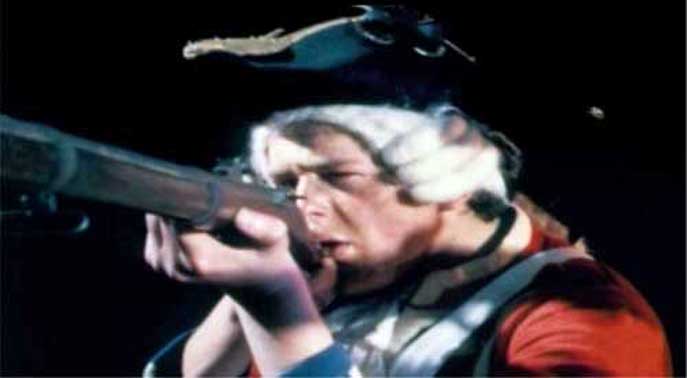
In February of 1692, under government orders, a regiment of government soldiers from the Duke of Argyll's (Campbell) militia, came into the glen. Most of the troops were Campbells, or septs of the Campbells [James Hunter, Author/historian], but the strict code of hospitality required the MacDonald Chief, and his people, to give food and shelter to the unwelcomed guests. But as will be seen, this was no social visit.

Tragedy at Glen Coe (Glencoe)
In 1688, William of Orange the Dutch Prince, invited to Britain as King, for fear of the Stuarts, asked the English Parliament to oust the current King James VII of Scotland and James II of England because of James II's own rule that stated: "...attending a Covenanting (a secret meeting of Scots Presbyterians) act of worship was a capital crime", and many Scots Presbyterians paid the penalty, losing any love for James II they might have had. James II alienated all the peoples support he depended on, and he was ousted from the throne of England and Scotland in 1688, the last of the Stewart Kings.
He had been ousted, primarily, by William of Orange, a Dutchman invited to England and with the strong of encouragement and support of the Parliament. Whilst James II accepted his exile, others did not, and they fought back. The intensely brutal battles went back and forth. Scots Protestants fought English Protestants, both fought the Catholics.
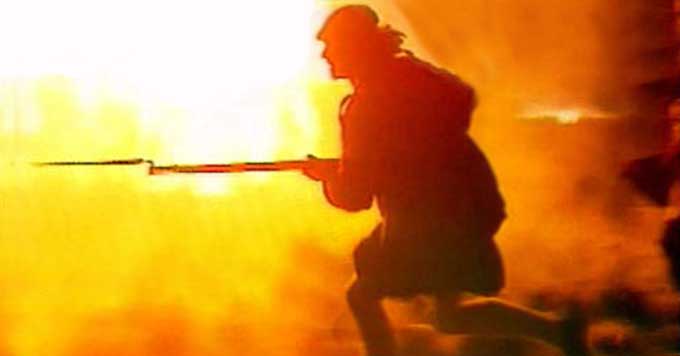
Many Highlanders, who still had Catholic and/or Episcopalian beliefs, or at least empathy for their Irish cousins, fought with zeal against the English church and especially against the Lowland Scots Covenanters (later Presbyterians). Here is an eyewitness account of the Highland anger from battle of Killecrankie: "The regular (English and Lowland Scots governmental British) troops followed their routine of firing a musket volley and then fixing bayonets to charge. They had no time to fix the bayonets before the wild Highlanders were on them, screaming and flailing their Claymores" (6 foot 2-handed sword).
"General MacKay's , (British) men were killed in the hundreds"
The fierce battles went on.......................

Scotland didn't quite settle down to peaceful times, despite their victories - old divisions to precarious to be thrown out. Loyal or not to William of Orange, they had a bitter sense of grievance against him. Many Scots objected to the intolerance, anti-Presbyterian intolerance, of the Stewart (or Stuart in it's French spelling) Kings. They were almost equally outraged by the tolerance of William. This is somewhat typical of the confusing Scottish/English relationship.
Some Scottish legends claim William of Orange as the valiant champion of the Protestant cause against the Catholics. (Of course Highland opinions on the matter varied considerably). The "Protestant Champion" King William did rid Britain of a Catholic King -- James II and VII (of England and Scotland respectively). It was, in fact, just a political manoeuver against James II, not a religious one. William of Orange was on friendy terms with the Pope -- had Catholics in his army in highest ranking areas, and more. But, inevitably, history still sees William of Orange, as the patron saint of hardline Protestantism. It simply wasn't that simple; It simply wasn't the truth.
Thankfully, at least by all appearances, the religious wars of fury, hate and blood came slowly to a halt. With religious peace or tolerance, came the need for political peace, particularly among the Highlanders, who were largely cut off from Lowland society, and who included many subjects still loyal to the deposed King James II and the different faith that many Highlanders, though not all, still clung to -- in a "Scottish way" That, is typical of Highlander stubborness and determination.

The Glencoe Tragedy
William of Orange was seen as a hero to many (mostly Lowland) Scots and Englishmen; truth was, he was simply not very interested in Scotland. His minister for Scotland , John Dalrymple "Master of Stair", who took charge of the Royal Ordinance that all Highland Chiefs of Highland clans must abandon the old Stuart (Stewart) loyalty and swear fealty to William of Orange.
Highlanders swearing loyalty or fealty to any King is a diffucult thing to accomplish.During a time when a large portion of Scots Highlanders were still Catholic, due mostly to the "Auld Alliance" with Catholic France. To swear loyalty to the anti-Catholic, anti-Stuart , anti-Scots Highlander; anti-French (Scots Ally) and on top of it all, swear to an English King from Holland! Not even an English born English king, was hard to understand.
The English King, William of Orange and his advisors, felt it was "necessary" to deal with the troublesome Highland Scots. The Scots had been in rebellion over King James II & VII being exiled in France, and these rebellions led to the Jacobite rebellions against England. Note that the Jacobite rebellions also included many Lowland families as well (such as the Grahams), but they were initially supported only by Highland clans. So the King of England, William of Orange sent his man, Dalyrmple, known as "Master of Stair of Scottish Affairs", to force the Highland Chiefs to swear an oath of loyalty to William and abandon exiled James II & VII. But the Stair (Dalyrmple) had a personal grudge against a small sect of MacIans of the Clan MacDonald, for participating in the rebellions and, he claimed, cattle reiving (stealing). The real motive seems to have been one of support for the Jacobites (under Dundee, who fought for the Stuart cause) ; a Catholic Stuart king.
Worse still, there was a 'closing date' (deadline) for the oath, on New Years day, 1692, and what would become of this dictatorial ordinance was to be a legendary bloodbath that tainted William's reputation for all Scots and many English.
Many argue, even today, that the following incident was "minor" in comparison to other atrocities in Scots/English history. In terms of numbers, yes, it is minor. But I shall let you, the reader, decide whether or not this account of Glencoe sounds minor to you .....the eyes of a first time reader of this tragedy, rarely lie to the individual.
Having no real choice, the Highland Clan Chiefs did what was demanded. However, one minor chieftain MacIan of Clan MacDonald, got it wrong. He took his oath to Fort William, (as he claimed he was told -- and there is truly no reason to doubt his claim) , but upon arrival at Fort William, he was told that the proper place to take his oath was Inverarary.
There is ample evidence that this was done by Dalyrmple to be sure the clan Chief would arrive late. So, in the deep of cold mid-winter, he went there but arrived a few days late due to the misdirection and deep bitterly cold winter weather. The sheriff who was to receive his fealty and oath, was also late -- later even than the Chief. When the sheriff arrived, he accepted MacIans oath. What no one suspected was that the "Master of Stair" , John Dalyrmple, had a personal grudge against the MacDonalds for their participation in the cattle reiving and supporting Jacobite causes, (the word Jacobite being a form of the word James from Jacob), but most of all, because they were supporters of exiled James II and considered Papists. William of Orange's man, John Dalyrmple (Master of Stair), took the view that the declaration (oath) was invalid because it was two (2) days late, and ordered a Campbell regiment to do a "job" for him. This Campbell was Robert Campbell of Glenlyon (Glen Lyon). He was to extirpate the MacDonald's that Dalyrmple detested.
John Dalrymple (1648-1707) was a judge. His father had held the position of first Viscount Stair (earl), a succesful Jurist and defender of Covenantor values. John, the son, had always been sensitive to the fact that his father had resigned his post rather than take the "Test Oath" and John had come to friendly terms with James II, the Catholic Stewart King, early on in his career. When James was forced into exile, and Lowland and English hate of the Catholic Stewarts had grown strong, [Collin's Scotland, 1996], Dalrymple had a switch of faiths. Like his father, he was an able but unscrupulous man. He was appointed by William of Orange to the posts of Lord Advocate and then Joint Secretary of State (over Scotland) with Melville in 1691. He was given the responsibility of controlling the rebellious Highland Jacobites, and lacking the troops to overcome them initially, he put into action, with his Campbell conspirators, and with the blessing of King William, a sinister plot. Sensitive to accusations by protestants that as a previous supporter of Catholic exile James, he still had Catholic leanings, and sharing with many other Lowlander Scots a fear and loathing of Highland clans, he determined to make an example of the "worst of the worst" of clans - the small reiving, and Jacobite supporting clan of MacIan MacDonalds.
The clan Campbell had been working with the King's for almost two centuries, policing other clans in the name of the Throne; reporting other clans to the king; massacring rival clans ( i.e. the Lamonts) and taking their lands as their own; and ocassionally wiping out clans the Scottish and later the British government didn't want to deal with any longer. The Campbell's were not always willing pawns of the English. The Campbells, such a proud and powerful clan - in the days of Wallace and Bruce and over two centuries after Bannockburn (1314) , had aligned themselves solely with the Scottish Kings against, initially, the Lords of the Isles who saw themselves as independent. This eventually led to alignment or loyalty to the British - (Union of the Crowns, 1603, Union of Parliaments 1707).
They became the eyes and ears on Highland activity for the government -- they turned traitor to Highland Scotland and with their continual feuds with the MacDonalds (amongst others) they were more than willing to do this "job" for the government forces.
The horric incident that would scar King William of Orange's and the Campbell's names occured in 1692.
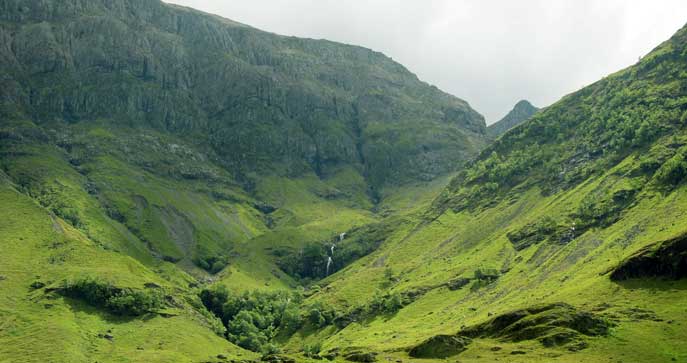
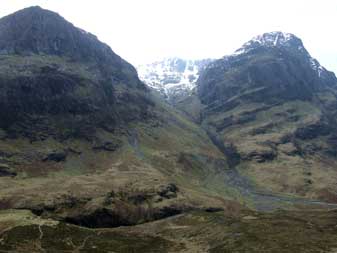
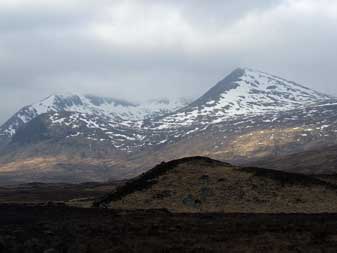
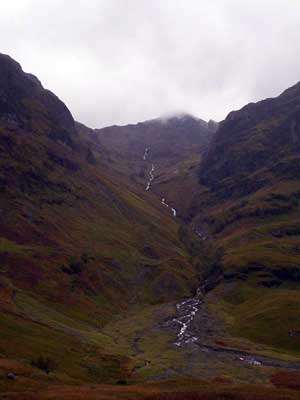
The place was the valley Glencoe, which has a bleak and forbidding atmosphere even in bright sunlight, (and it is still that way today), as if the hills remember black treachery and blood.
Glencoe is where the little community of the MacIan's, of small sect of the MacDonald clan, lived. The MacIan MacDonald's were no angels having raided cattle of their southern neighbours before. But their biggest crime, in the eyes of the Protestant British Government, was being Jacobite sympathisers. In early winter, 2 February 1692, the small clan of the MacIan of MacDonald's, generally, simply referred to as MacDonalds, were visited by the detachment of Campbells (the majority of the soldiers were Campbells by marriage or sept - [from James Hunter, "Battle of the Highland Clans", Scottish historian in Scotland], and their Highland mercenaries. From all accounts, they were received with hospitality. The Chieftain's were related by marriage. The Campbells and their troops stayed for nearly two weeks and were on friendly terms with their hosts.
At this time it needs to be pointed out that the regiment sent to deal with the MacDonalds were not only of Campbell members or clans. They had various names in their ranks from all over Scotland, but it was clear they were under the direction of the Campell commander, Robert Campbell, and he was under clear direction of Dalrymple - thus also William of Orange. To look at this incident as a clan feud or a Clan Campbell versus the Clan MacDonald would be incorrect and misleading.
Despite the fact that they did and were often at odds with each other, and did indeed feud, this was a military operation of ruthless severity ordered by British government stooges. I have referred several times in the following article to the perpetrators of the barbarous crimes as the Clan Campbell, which is not 100% factual, but almost all Scottish experts that write on Glencoe, including the highly respected authors John Prebble, Fitzroy Maclean, Tom Steele, etc, refer to the perpetrators as members of Clan Campbell because (1) a majority of the garrison were from the various branches of the Campbell clans (and septs), and (2) the real Campbell involvement was the Earl of Breadalbane who was involved from the outset in the planning and organisation of the massacre. Also involved in this planning was the Earl of Argyll (Campbell). If I could in good conscience call the guilty parties by some other name -- I would. But the fact remains it was a major incident in Campbell and Scottish history. To back up this claim, one needs only to look at the conspirators of the planned massacre, who after Dalrymple and Duncanson, were heads of the Breadalbane and Argyll branches of the Campbell clans in confederation with the Master of Stair, and his boss, King William of Orange.
A quote from Dalyrmple, the main organiser, shows he feelings regarding the MacDonald's:
"[The] Glencoe [Chief] had not taken the oath [he did but late] , at which I rejoice! It will be a proper vindication of public justice to extripate that sect of thieves. It must quietly done. Let it be secret, and sudden." -- Master of Stair, Dalyrmple.
At least by all appearances, the visit from the Campbells was a good one. There was much drinking, feasting, dancing and harmony. The guests stayed for two weeks.
But in the still dark early morning, 13 February 1692, the guests arose and systematically set about viciously murdering their hosts. Women and children were not spared.
The Campbell's orders from King William's man in Scotland, John Dalyrmple --- "Master of Stair" , were quite brutal and clear. The orders were snt to Major Duncanson who relayed them to Robert Campbell of Glenlyon and carried the kings personal authority in a sealed order.
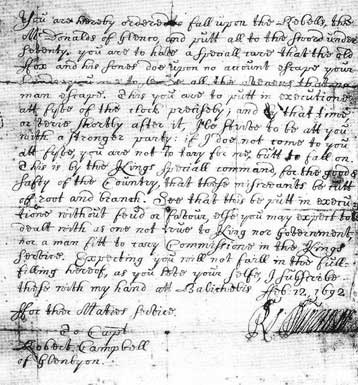
The Note read such:

To Captain Robert Campbell of Glenlyon
' For Their Majesties' Service'


(In old English, exactly as it appeared)

Sir, You are hereby ordered to fall upon the rebels, the M'Donalds, of Glencoe and putt all to the sword under seventy. You are to have special care that the old fox and his sons doe upon no account escape your hands.

You are to secure all the avenues, that no man may escape. This you are to putt in execution at five o'clock in the morning precisely, and by that time, or very shortly after it, I'll strive to be att you with a stronger party. If I doe not come to you att five, you are not to tarry for me, but to fall on.

This is by the King's special command, for the good of the country, that these miscreants be cutt off root and branch. See that this be putt in execution without feud or favour, else you may expect to be treated as not true to the king's government, nor a man fitt to carry a commission in the king's service. Expecting you will not faill in the fulfilling hereof as you love yourself, I subscribe these with my hand.

(John Dalyrmple) via Duncanson.
The "old fox" was the clan Chief of the MacDonalds. The "king" referred to was William, Prince of Orange. This writer isn't trying to make a judgement on either clan, both had their heroes and demons. All clans did. But the Campbells of Breadalbane, led by Sir Robert Campbell and with his men, stayed with the gracious and generous MacDonalds of Glencoe for nearly two weeks, drinking, making hay among other things, generally having a spontaneous ceilidh (kâ´lê), [an Irish or Scottish social gathering with traditional music, dancing, and storytelling]. Then suddenly, without provocation or warning, the Campbell guests stirred into action at five o'clock in the morning. They set about slaughtering all the defenseless, unarmed and helpless MacDonald's they could find, in the darkness of a black early morning of despair.
In a sudden snowstorm, many of the shocked MacDonalds escaped into the pitiless bitter cold snow and many perished from exposure. About forty members of the small clan of Ian of MacDonald , including Ian, the Chief and his family were ruthlessly slain in cold blood. Among the foully murdered were also two children and two women.
After killing the MacDonald Chief, the murderers had ruffed up and possibly violated his wife, and in the process a soldier bit the finger off her hand to get her gold ring, because she would not give it up to them. She was left to die in the cold. A child of six, trying to hide behind a soldier, was bayoneted without remorse. We are often told of the 38 that died at the hand of the Campbell regiment, but as many as one hundred more may have died of exposure to the snow and cold after fleeing from their would-be murderers. The numbers could be as high as 100 dead. [Battle of the Clans.]

The Proof is in the Conspirators.
However, some did survive, despite serious injuries. The Massacre of Glencoe enraged Scotland with its treachery and lead to years of feuding in the Highlands. England's King William III's agent John Dalrymple, 44, Earl of Stair, suppressed news of the oath taken six days late, by Ian MacDonald, chieftain of the MacDonald Clan at Glencoe, and conspired against MacDonald with Archibald [Campbell] Argyll, 41, and with John Campbell, 57, first Earl of Breadalbane.
The actual massacre was led by Sir Robert Campbell of Glenlyon. If ever more proof were needed, the above mentioned names and their involvement in this slaughter, is an indictment itself.
Just a quick glance at the above named conspirators and the man who led the fatal expedition, Sir Robert Campbell of Glenlyon, a drunken aging soldier who had had run-ins with branches of the MacDonalds previously. It is clear from the names, that even if the whole of the Clan Campbell was not involved, enough of the leadership of the clan(s) were, that the blame rightfully does fall on their shoulders despite their denial of doing anything wrong, to this very day. The claim of "We were just following orders" or "it was stricltly a military operation" has a fascist sound that does not let the clan off the hook so easily.
This atrocious slaughter carried out upon the a small clan of MacIan MacDonalds, was initiated by the King of England himself, despite his denial, his man, John Dalyrmple (Master or Earl of Stair) and the Campbell conspirators proved beyond any doubt to the Highlanders, that England and portions of Lowland Scotland had been behind the slaughter. At least the leaders of these areas.
It isn't the number of casualties that is so shocking, rather, the manner of it, and the treachery of it. The MacDonalds opened their doors of rather modest homes, and generously let the Campbells inside their abodes. The Campbells said they were lost in the snow and asked to stay for a while, warm themselves and rest. Graciously, the MacDonald's agreed to let all the Campbell men and their Highland allies into their humble dwellings, trusting in God, that they were doing the right thing. They fed them their winter preserved meat, their wine, ale, friendship and by some accounts blossoming love among the younger folk.
The role of the Goverment and the monarch were debated for a long time. As stated in the Encyclopedia in the late 18th century:
"In various acts of the privy council of Scotland, the clan Gregor is denounced (proscribed) in the above terms, and was visited with all the terrors of "fire and sword". "their habitations were destroyed. They were hunted down like wild beasts. Their very name was proscribed." We have already referred to, in its proper place, a mandate from King James V in 1583, against the clan Chattan, in which he charges his lieges to invade the clan "to their utter destruction by slaughter, burning, drowning, and otherways; and leave no creature living of that clan, except priests, women and bairns."
Less than one hundred years later, the Highlanders was still be dehumanished and villified. Even Captain Burt, in the beginning of the next century writes of the Highlanders as if they were an interesting race of semi-barbarians, many of whom would cut a man's throat for the mere sake of keeping their hands in practice.
Far from having regret at his involment in the massacre, Dalrymple stated this after the fact:
"All I regret is, that any of the sort got away; and there is a necessity to prosecute them to the utmost." Again, writing to Colonel Hill in April of the same year, he tells him that "as for the people of Glencoe, when you do your duty in a thing so necessary to rid the country of thieving, you need not trouble yourself to take the pains to vindicate yourself. When you do right, you need fear nobody. All that can be said is, that, in the execution, it was neither so full nor so fair as might have been." -- From a letter of 5 March, 1692, after referring to the universal talk in London about the transaction.
Had the clan been proceeded against in open and legitimate warfare, resulting in its utter extinction, the affair might have occupied no more than a short paragraph in this and other histories. There can be no doubt that what gives the deed its nefarious stamp, is the fiendishly deliberate and deceitful way in which it was accomplished, in violation of laws of hospitality which are respected even by cut-throat Arabs. And after all it was a blunder. (Encyclopedia Britannica, 1785).

Punishment?
No active measures in the way of punishing either principals or subordinates, however, were taken in consequence of the findings of the commission and the recommendations of parliament, except that Breadalbane, who they found had laid himself open to a charge of high treason, was imprisoned for a few days in Edinburgh castle.

A curious and interesting incident came out during the sitting of the commission, tending to show that Breadalbane was conscious of a very large share of guilt, and was fully aware of the heinous and nefarious character of the bloody transaction.

Some days after the slaughter, a person sent by Breadalbane's steward waited upon Glencoe's sons, and told them that if they would declare that his lordship had no concern in the slaughter, they might be assured that the earl would procure their "remission and restitution."
The claim has been made that even the drunken Robert Campbell of Glenlyon died honourably in battle. But in fact he died a natural death - or as natural a death as can be had from liver failure due to toxicity from alcohol.
Glencoe is known by most people now, as the site of the massacre.
Glencoe was once was a quiet, serene place. The actions of the Campbells involved, as well as the other men fighting with them, the involvement of Breadalbane, Argyll and Dalrymple is inexcusable, even by the often brutal standards of the day.
The late Campbell Chief tried to explain the massacre .....(paraphrasing) "...We did what we were supposed to do. If you receive an order from a superior commander -- you do it, and we did.....we were just obeying orders."
That type of black-hearted remark is exactly what keeps some names, forever cast in a dark evil world, full of inhuman things. A world of disrespect, total irregard or indifference to innocent human life. It makes for nauseous reading, but it is part of Scotland's history, therefore, a valid topic. It is even more so because the current attitude amongst the clans involved now want to bury the issue by claiming it was just a minor incident and that only 38 people really died. True, only 38 died ( by the hands of the Campbell soldiers - more by exposure) because they botched the operation and many members of the clan did escape - else the death tally would have run over two hundred. As many as 50 - 100 did die of exposure, no one is quite certain of the number. But add that to the 38 killed outright, and over 100 were killed.
Ironically, there is now a "Glen Coe Centre" which was funded, for the most part by the Clans Campbell and MacDonald to both put aside the old image of brutal slaughter (bad for tourism and bad for the clans' images) and to make a hefty profit from unsuspecting Scottish descendants coming to visit only to be told it was just a minor incident and that the past is the past now and we should just forget and move on. I had a member of Clan Campbell (a high ranking one) write to me from my website asking I take down the story as it was totally inaccurate. I challenged him to tell me the "real" events. He was unable to deny the clans involvement in the end but insisted it was strictly a military maneuver, that it wasn't a personal bloodfeud and it was very long ago.
I suppose the fact it was a military operation to annihilate innocent civlians under direct orders from a British king is alright by some. But not to this author - never. I will continue to write the truth of Scottish history and sometimes that includes the ugly facts such as Glencoe.
This conclusion is supported by a quote from Scottish historian and Author, James Hunter, who recently said:
"What particularly distinguishes this act from others, and why it resonates today, was the absolute betrayal of the [tradition of] Highland hopitality by the Campbell forces. And the other was the hand of the government in it - the government had ordred it. It was a genocidal act." -- James Hunter, Scottish historian
The black treachery of this horrible incident has inspired many songs and stories. I have included one of my favourite Scottish songs -- originally known to this author as the "MacDonald's Lament" or now more commonly known as "Massacre at Glencoe" or "Glencoe".
These are the words to the song "Massacre at Glencoe", sum up the way many still feel about the horribe deed. These words are below:
Members of Clan Campbell, under orders from King of England - William of Orange's men, were sent to kill all of a small family of MacDonald's under the age of seventy. No one else was to be spared. The Campbells and allies, carried out this horrific act after spending nearly two weeks living at the modest MacDonald's home in Glencoe.

These are the words to a song, immortalizing the black deed that some members, under Robert Campbell of Clan Campbell of Breadlabane, carried out on the helpless MacDonalds. The year was 1692.

A Scottish lament
{ CHORUS }
Oh cruel as the snow that sweeps Glencoe,
and covers the graves o' Donald (Donnell),
Oh cruel was the foe that raped Glencoe,
and murdered the house of MacDonald.

They came in a blizzard, we offered them heat,
a roof for their heads, dry shoes for their feet,
we wined them and dined them, they ate all our meat,
and they slept in the house of MacDonald.

Repeat Chorus ----

They came from fort William, with murder in mind,
the Campbell had orders, King William had signed,
put all to the sword, these words underlined,
leave no one alive called MacDonald.

Repeat Chorus ----

They came in the night, while our men were asleep,
this band of Argylls, through snow soft and deep,
like murdering foxes, among helpless sheep,
they slaughtered the house of MacDonald.

Repeat Chorus ----

Some died in their beds, at the hands of the foe,
some fled in the night, and were lost in the snow,
some lived to accuse him, who struck the first blow,
but gone was the house of MacDonald.

Oh cruel as the snow that sweeps Glencoe,
and covers the graves o' Donald,
Oh cruel was the foe that raped Glencoe,
and murdered the house of MacDonald,
and murdered the house of MacDonald.

Words: J. McLean

Fortunately some MacDonalds escaped to tell of the slaughter. Yet before we condemn the Campbells for this horrifying act, this is the same clan, several centuries earlier that helped an outlaw named Robert the Bruce, who was hiding from the English and enemy Scots alike, shortly after being made king of Scotland.
It is easy to look at the Highland Clans now, and make judgements against or for them. It was not so black and white then. Of course, what the Campbells did was terrible, and for that single act, they are remembered by many, many Scots for this incident, in a bad light.
No present day person is responsible for any crime against the Glencoe MacDonalds. Nor are they responsible for the crimes of their distant relatives. I am simply telling history, on this ONE article, from a Scottish Highland perspective. Not all Scottish history is full of proud moments and ALL clans have their ugly sides. This one stands out because of the nature of the crime, and the fact that it was endorsed, nay, encouraged by the king himself.
RM GUNN, MA Author, Medieval Historian

This article may be freely shared and distributed for use by various clan organsiations and Scottish societies, with permission and consent of the author so long as the link to the author's page is included.

Back to Top