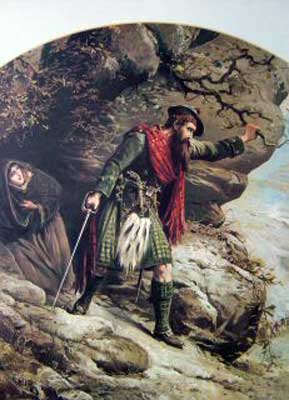
Saturday, April 12, 2014

SCOTS-IRISH AND THE FORCED HIGHLAND CLEARANCES


THE MOVEMENT OF PEOPLE BETWEEN SCOTLAND AND IRELAND - AND ONWARD EMIGRATION TO NORTH AMERICA, AUSTRALIA AND NEW ZEALAND

Notes covering the origins of the Scots and Irish peoples, some aspects of the history of England, Ireland and Scotland; the clearances in Scotland; associated religious disputes and the Covenant: all being influences on the movement of Scots people to Ireland and onward to the former British colonies or directly to those colonies. Includes a list of potentially useful references.
Compiled by Iain Kerr email 100425.1036@compuserve.com
I have been asked by a number of conventional correspondents and more recently contacts on the CompuServe Genealogy Forum to answer queries on the background to the emigration of Scots and Irish people to the Americas and beyond. These notes cover the main historical background to those movements. They attempt an approximately chronological outline of the major incidents which caused population movements in Scotland, from Scotland to Ireland and either directly, or through an intervening refuge, from Scotland and Ireland to the Americas and later Australasia.

Introduction

The racial mixture of the populations of the British Isles is highly complex; largely due to the continued movement of significant portions of the population throughout recorded history. The population of Scotland in the 16th and early 17th centuries was made up from the remnants of the early Celtic inhabitants of the British Isles, of Roman invaders and settlers, the Angles, Jutes, Saxon and Viking invaders of the Dark Ages from continental Europe, later Flemings from the Low Countries and the Normans (themselves of Viking origin) who came north after the conquest of England in 1066. The Irish population at the same time was a mix of the early Celts, Picts and other Hibernian invaders plus Viking and other incomers.
The movement of people between Scotland, England and Ireland over the centuries has been driven by a variety of pressures; political, economic, family ties, religious issues and the problems suffered during times of all types of armed conflict and war. There is also a very long history of such movements from the days of the Viking invaders in the Dark Ages of the 5th to 7th centuries up to the times of the potato blight in Ireland of the mid 19th century.
Some movements have sometimes been loosely referred to as clearances; there were several actual clearance campaigns in Scotland and in Ireland, conducted either directly by the English/British Crown or by substantial land-owners on with the tacit support of a benign government. Although history and romantic fiction tend to focus on the Highland Clearances in Scotland, they were effected across the whole of Scotland; evicting, if not wiping out, the resident Highlander, Lowlander or Borderer populations. Similarly, the massive movement of people from Ireland before, during and after the potato blight and consequent famine (the Great Hunger) of the 1840s has attracted much interest; sometimes obscuring substantial but otherwise routine movements at other times.
The "dark romance" of such Celtic evictions obscures the scale of movements of people from other parts of Britain and Europe. There are clearly documented forced migrations of people, especially religious minorities or economically disadvantaged classes, from the south west of England to the Americas and from Kent to Australia. A remarkably similar modern campaign, the forced emigration of orphans from all parts of Great Britain to Australia, only ceased in the 1950s.

Geographical Factors

It should be recalled that the West Coast of Scotland has a mass of sea- lochs and two belts of islands; the Inner and Outer Hebrides. Furthermore, the County Antrim and County Down coasts of Ireland are very close to Scotland, north-west England and the Isle of Man. The local fishing industry, small-scale trading and the historic movements of populations ensured ready movement by sea between what are now seen as separate countries. In times of crisis, famine or war it was sometimes safer to move family and flocks to another safer or more economically attractive residence. Such escapes were often followed within a generation by a return to the original homeland once conditions there had returned to normal. It is understandable that the family histories of many of the surnames represented in Scotland, Ulster and even Northern England are quite confused.

In an extreme example of routine movements, it should be recalled that in the 18th and 19th centuries, the people of St Kilda (some 40 miles into the Atlantic, west of the Outer Hebrides) were prepared to row to Uist or Harris, against prevailing winds and seas, in order to trade their sole produce, the down of the island's sea-birds for use as mattress filling.

The Beginnings

The troubles in Scotland began in the reign of King Henry VIII, who was attempting to wage war on France - Scotland's "auld allie". Henry defeated King James IV at Flodden Field on 9 September 1513. The Scottish Crown fell to a series of young, often infant monarchs, who were under the influence of their Mothers or Regents. The Regents inevitably were the powerful barons of Scotland, who feuded for that power. The disputes between the barons becoming more complicated with religious differences; between Catholic, Presbyterian and Episcopalian (Anglican).
The uneasy peace between the two kingdoms broke down during the Reformation with the rise of Presbyterianism in Scotland and the evolution of Anglican church in England. King James V attempted to assert Scots power, but after defeat in battle, Henry's armies invaded Scotland and beat the Scots at Hadden Rig near Berwick in August 1542. The Scottish Army then mounted a counter-attack at Solway Moss which turned into a rout with the Scottish Army suffering many casualties.
The families of the defeated Scots soldiers were immediately at risk. No sooner than the battle of Solway Moss was over than the retreating Scottish Army found itself beset by Borderers or border reivers - those families who lived in the Border Marches, where neither English or Scottish Crown held sway. The reivers were eager as always to snap up plunder and prisoners, whichever side they belonged to. Some of the Scottish soldiers who escaped were reputedly so reduced by panic and confusion, that they were prepared to surrender to women. The news of Solway Moss was literally a fatal blow to the sick and dejected King James V who died in despair at Falkirk. No sooner was his body cold than the Scotts and Kerrs, down on the English Border, were raiding the royal flocks and farms.

Henry's Rough Wooing

The Scottish crown passed to James' infant daughter Mary, Queen of Scots. Henry VIII sought to gain control over Scotland (and to advance his cause against France) by proposing marriage with his infant son Edward, Prince of Wales under the Treaties of Greenwich of August 1543. The treaties were rejected by the new Scottish Parliament. Henry's response was to loose his English troops upon Scotland with instructions to kill, burn and spoil. The invasions of Scotland in 1544 and 1545, known as Henry's "rough wooing", brought slaughter, burning and indiscriminate extermination wasting southern Scotland and inflicting irreparable damage on the Scottish abbeys and driving the populations away deeper into Scotland or across the sea to Ireland.
The work was entrusted to Edward Seymour, Earl of Hertford. By threat and bribe he revived the old English Warden's policy of securing the toughest of the Scottish clans to work in England's interest; the time would come when he could claim that he had turned Dumfries into virtually an English province. In the meantime he managed to control the Scottish reivers' activities to an extent that the old Lord Dacre had not achieved. He played skilfully on the feuds which, as always, were in progress along the line, turning the Armstrongs on to the Kerrs and Scotts who were themselves engaged in their perpetual vendetta.
Henry maintained suzerainty over Scotland until, losing campaigns in France, the English armies were withdrawn from Scotland in 1550.

Religious Ferment - the Reformation

The next 20 years of Reformation in Scotland saw the firm establishment of the Calvinist Church of Scotland (the Presbyterians), although there were still Roman Catholic communities, especially in the Islands and West Highlands, and a significant minority who tended to an Episcopalian Church. This event is focused on the Confession of Faith (later to be revived as the Covenant) and by the Act of Settlement of 1560. Two decades of confusion followed during the attempted Counter-Reformation by Roman Catholic supporters of Mary, Queen of Scots. Mary abdicated in 1567 and Scotland was governed by four disputatious Regents during the childhood of King James VI. Mary was executed at Fotheringay on 8 February 1587 by order of Queen Elizabeth I. James VI succeeded to the English throne on Elizabeth's death on 26 March 1603. James VI and I, as he became after being crowned in London, continued a campaign to bring order to the Borders, begun in the 1590s, and sought to do so by sending some of the Border reivers to serve in the Continental wars.

James VI and I - Highland Clearances

James VI and I, although absent from Scotland for most of his reign, pursued a campaign to bring into order the 'peccant' parts of the realm - the Borders, the Highlands and the Islands. For example, the 7th Earl of Argyll led the pursuit of and violent measures against the MacGregors under a commission of "fire and sword" of 1610. In 1617, Parliament confirmed a Privy Council ordinance of 1603 which abolished the very name of MacGregor. These pressures contributed to the significant number of Scottish (and Irish) emigrants in the first colonial ventures in the North Americas. Some of the Scots settlers established Nova Scotia under the leadership of Sir William Alexander, afterwards Earl of Stirling.
The later years of James VI and I reign saw gradual revelation of his personal adherence to the Roman Catholic church and to more overt support for the reintroduction of the Episcopal Church in Scotland. His persecution of the English Puritans and the Scottish Presbyterians were to create more emigration pressure during the reign of his son Charles I.

Presbyterian Revolution - The National Covenant

Charles I, who claimed to be King of Great Britain, continued his support of the Episcopal Churches in Scotland and England and maintained closer relations with Catholic allies in Europe. Charles was uncompromising in his dealings with the Scottish, as well as the English, Parliaments and with Archbishop Laud, proposed that the Episcopacy be re-introduced in Scotland. The Scottish opposition to this was both general and intense. The Scottish Parliament and Kirk produced the National Covenant on Wednesday 28 February 1635. In an astonishing "avalanche" the Covenant was rapidly distributed throughout Scotland. By years-end, 95% of the Scottish people had bound themselves to the Covenant. The Covenant bound its adherents to "uphold and to defend the true religion" and to oppose all "innovations on the purity and liberty of the gospel". This led to the so- called Bishop's Wars.
The Scottish Parliament seized the royal fortresses and stores, made an alliance with France and sent an army under General Alexander Leslie across the English border early in 1640. The Scots were well prepared; the country was filled with old soldiers who had served Germany in the Thirty Years war who served as the nucleus for untrained levies. Leslie seized Newcastle. King Charles responded by calling his fourth, the so-called Short, English Parliament which was dismissed after 3 weeks.
King Charles having failed to regain power in Scotland, then made a truce with the Scots and called the fifth, or Long, English Parliament which met on 30 November 1640. In 1641, the English Parliament, which was packed with anti-monarchists and libertarians (who became the Puritan Party), presented the King with the Grand Remonstrance which recited all of the acts of tyranny and misgovernment of the previous sixteen years. King Charles attempted to arrest five of the members of Parliament but failed and on 10 January 1642 he left London, never to return, save as a prisoner.

The First English Civil War 1642 - 1649

In 1643, a General Assembly held in Edinburgh accepted the overtures of the English Parliament - the "Solemn League and Covenant". Both parties agreed to preserve the reformed religion in England and Ireland and to suppress all opponents of the League and to preserve peace between England and Scotland. 

Covenant

The Presbyterian cause was joined. In 1643, the Scottish Covenanting Army, under Leslie, swept the royal forces before him and advanced to besiege York before playing an important part in the battle of Marston Moor.

Montrose's Venture 1644 - 1645

Montrose, who had refused to have any part in the Solemn League, accepted the King's commission as Lieutenant General, commanding the Royalist Army in Scotland. After defeat at Marston Moor, he returned to Scotland in disguise and raised a small force including some 1,000 wild Irishmen and Islemen commanded by Alistair MacDonald. Montrose led his small force to victory in six battles against the odds and carried fire and sword into the lands of the Campbells. Just when the Lowlands lay before him, Montrose was defeated by Leslie at Philliphaugh. But the Covenanting victory was stained by a horrible massacre of Royalist prisoners, echoing that which has occurred after the Battle of Naseby. The first English Civil War ended with the impeachment, trial by Parliament and execution of King Charles I in 1649

The second English Civil War 1651 - 1652

Immediately after the execution of King Charles I in Whitehall, the Scottish Parliament proclaimed King Charles II as monarch. The King accepted this odd offer which was conditional upon his recognition of Presbyterianism and, arriving from his exile in The Hague, Netherlands, off Garmouth on Spey, he signed both Covenants on 23 June 1649. King Charles II was crowned King of Scotland at Scone early in 1651. Cromwell could not accept this and in July he crossed the Border with 16,000 men, mainly veterans, and a fleet sailed up the east coast. Cromwell seized a tactical advantage at the Battle of Dunbar. In victory he showed no mercy and the few able Scottish survivors were sentenced to exile in the 'Plantations' of Ulster and the Americas.
He then led his Royalist armies in an attempt to regain power in England. This failed with defeat at the Battle of Worcester where Highlanders, following the Royalist cause into England, fell in significant numbers. The Highlander's homelands became forfeit to the victorious Roundhead supporters; their families refugees. King Charles had a long and exiting journey into exile in France.

The Usurpation (Commonwealth and Protectorate) 1649 - 1660

The English Parliament under Cromwell first attempted to treat Scotland as a mere province and attempted to create a Union between the nations during the Barebones Parliament (which contained only 5 Scots members out of 140) with Cromwell as Lord Protector. The Commonwealth and Protectorate broke up as an institution after the death of Oliver Cromwell and the succession of his son Thomas as Lord Protector. The restoration of the Crown in 1662 came as relief to most Scots because they were Royalists at heart and hoped to be permitted to practice their own form of Presbyterianism which emphasised the direct responsibility of every individual to his Maker.

Restoration and the Covenanters 1660 - 1689

               Scot  Covenanters

King Charles II has sworn at his coronation in Scotland in 1st January 1651 to uphold the Solemn League and Covenant and to establish a Presbyterian Government. The crown was placed on his head by the Marquis of Argyll. Yet, little more than a year after his restoration to the throne, Charles had Argyll executed at the Cross of Edinburgh because Argyll adhered to Presbyterianism.
King Charles II, known to his English subjects as "the Merry Monarch", was wont to say that Presbyterianism was no religion for a gentleman and restored the Episcopacy in Scotland. He quickly developed had a vindictive attitude both to his former enemies and to the Presbyterians in Scotland who had been his allies. In England, the Act of Uniformity 1662, the Conventicle Act of 1664 and the Five Mile Act of 1665 were concerted efforts to persecute those Protestants who failed to accede to the 49 Articles and the Book of Common Prayer. In Scotland, the Act of Proclamation 1662 banished from their manses and parishes all ministers who lacked an episcopal licence. The result was that on 1 November 1662, over 400 ministers came out of their churches and manses. This was followed by the Act of Fines of 1663, designed to punish those revolting clergy. The enforcement of those fines was placed under military control using the newly formed standing Army.
The collection of those fines led to the first military rising of the Covenanters, at St John's Town of Dalry in Galloway on 12 November 1666. A small party of armed Covenanters overpowered some troopers under the command of Sir James Turner who were torturing a Covenanter who would not pay his fine. The Covenanters then marched from Dumfries to Lanark, increasing to some 2,00 in number. At Rullion Green they encountered the superior forces of the Crown under General Dalziel. 1,000 Covenanters who determined to go forward at all costs were disastrously defeated. Over 100 prisoners were taken to be afterwards executed after various degrees of torture at appointed spots all over the country. Other prisoners were subsequently transported as indentured labour to the Americas.
The persecution of the outed clergy and Covenanters, and anyone providing them shelter or support, continued along with heavy fines. By 1677, landowners and masters were required to sign bonds for all persons residing on their land. Their landowners refused to accept this impossible undertaking. The Government loosed upon the south-west, and Ayrshire in particular, the Highland Host - a body of 6,000 Highlanders and 3,000 Lowland militia who lived in free quarters while they extracted the bonds and looted the country. The simmering uprising led to the assassination of Archbishop Sharp, the symbol of the episcopacy and the persecutor of many Covenanters, at Magus Moor near St Andrews on 3rd May 1679.
Following the assassination, a company of Covenanting extremists held a Conventicle in Avondale on 25th May. They prepared a public manifesto, ratified at public meetings and published at Rutherglen on 29th May - a date deliberately chosen as the unpopular public holiday for the King's birthday. General John Graham of Claverhouse ("Bloody Clavers" later Viscount Dundee and "Bonnie Dundee") attempted an attack on the Covenanters at a great Conventicle at Drumclog on Sunday 1st June but was repulsed. This was one of the Covenanter's few military victories.
Three weeks later at Bothwell Brig, the 5,000 strong Covenanter Army was disastrously defeated by a Royal force under Monmouth; 400 being left dead on the field; and 1,500 carried away as prisoners to Edinburgh. There they were confined in the open for five months in Greyfriars Kirkyard. Two ministers were hanged, some other prisoners were executed at Magus Moor. [The names of all Covenanter martyrs are recorded on the National Covenant Memorial in Greyfriars Kirkyard.] 400 prisoners who took a bond not to rise in arms again were released. The remainder were sentenced to be transported to Barbados, but their ship sank off the Orkneys with 200 of the captives battened below hatches.
Monmouth, who was considered by the King as too kindly and lenient, was replaced by James, Duke of York (later King James VII and II). The strict Covenanters, reduced in numbers but not in spirit, continued to resist with increased fervour. Led by the minister Andrew Cargill and by Richard Cameron, a St Andrews graduate, they were known as the Society men" or the Cameronians. [The British Army regiment which bore that name for nearly 300 years, were known as "the Covenanters"; they took their rifles to the Kirk and posted sentries outside. The regiment went into suspended animation in the 1968, resolved to return should Scotland or the Covenant ever have need of them.]
On 22nd June 1680, the first anniversary of the dark day of Bothwell Brig, the Cameronians assembled at the market Cross at Sanquhar and published a Declaration for the deposing of the Stuart King Charles II. Cameron was killed at Airsmoss a few weeks later. But the Society People continued to harry the authorities.
The period of the Restored Monarchy in Scotland was a period of marked economic and political development. Yet the continued persecution of dissidents drove men to lands abroad where thought was more free. A small Quaker-Scottish colony was established in East New Jersey in the 1660s and in 1684; a Presbyterian settlement in Stuart's Town in South Carolina.

The Glorious Revolution 1688

James VII and II was proclaimed King of Scots on 10 February 1685 but he omitted to take the Coronation oath to defend the Protestant religion. The Indemnity which he published to celebrate his accession omitted all his Covenanting enemies. By 1688, the King's open support of the mass and promotion of Roman Catholics to power and office confirmed the fears of the English and Scots Protestants. The birth of a Prince of Wales in June 1680 [Prince James Frances Edward Stuart - the 'Old Pretender'] convinced the English magnates that James's policy would survive his death. They therefore invited William of Orange, the husband of Queen Mary, to take the English and Scots Crowns. The battles of the "Glorious Revolution" included the Battle of Killiecrankie where "Bonny Dundee" was killed commanding the western clans against the Williamite army. The Revolution ended in King James' final defeat at the Battle of the Boyne achieving what the Covenanters and other dissidents had striven to achieve - the firm establishment of a Protestant Crown for Great Britain. James and his family fled to France where amongst other things they changed the spelling of their name to Stuart.
The Revolution Settlement including the Treaty of Limerick, by which William of Orange became King de jure as well as de facto, was not universally welcome in Scotland. Opposition came from various quarters. The Jacobites, seeking the return of James, were still active; the Episcopalians resented the establishment of the Presbytery; the Cameronians were outraged by the disregard of the Covenant; and disappointed politicians united themselves in the 'Country Party'.

The Massacre of Glencoe

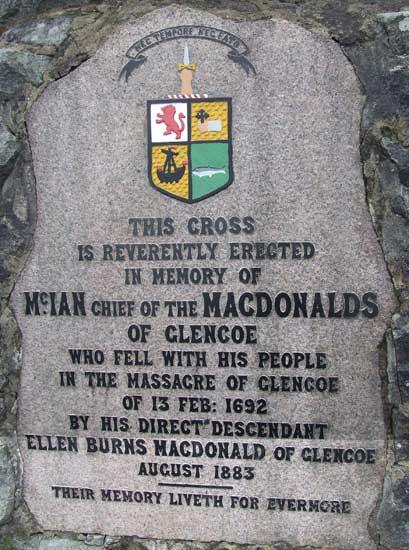
The newly established government promised indemnity to all Scots who would eschew any Stuart loyalties and take the oath of allegiance before 1 January 1692. They clearly hoped that the recalcitrance of the Highland chiefs who sympathised with the deposed Stuarts, would provide a pretext for a crusade against them. MacDonald of Glencoe (the leader of a small branch clan of the Clan Donald), partly through truculence and partly due to bad weather, was a few days late in giving his pledge of allegiance. 'Letters of Fire and Sword' were issued against his small clan also known as MacIans, which had a reputation for thievery, and was hated by the Campbells, who were serving the Crown. On the night of 13 February 1692, thirty-eight MacDonalds, including two women and two children, were treacherously murdered by a party of Campbells which had been quartered in their midst. The few surviving MacDonalds fled over the snow-clad mountains; some to Ulster where they changed their name to McDonnell. This was the source of a long-lived feud between the MacDonalds and the Campbells.

War with France

Another source of friction was that from 1689 to 1697, King William III was at war with France, and France was Scotland's old ally. Scottish money was spent and Scottish lives were lost - the Cameronians, for example, suffered dreadfully at the battle of Steenkerk (in modern Belgium) in 1692 - in a quarrel which was repugnant to Scots sentiment.

The Darien Scheme

William Paterson, a Scot whose claim on history was the foundation of the Bank of England, was less memorable to his own countrymen. In 1693, he set up a company to establish an entrepot on the Ithmus of Darien (now known as Panama) which would command the trade of the two great oceans. Scots put up L400,00 - about half of the national capital available - every Scot who had L5 to spare invested in the Darien scheme. The colony of New Edinburgh was set up in 1698 but fever, dissension and English opposition ruined the venture. The colony was abandoned with great loss of life (over 2,000 men) and capital (over L200,000).
The Scottish distrust of the English was further fuelled by the Act of Union of the Scottish and English Parliaments of 1707; an Act intended to unite the two nations, but all too often to the advantage of the English side. Discontent in Scotland remained wide and deep, being intensified by the ascendancy to the throne of Great Britain of George I, a German from Hanover, while the 'legitimate' Stuart monarch - the 'Old Pretender' or James III, was still extant. Four times over the next three decades it seemed as if the Stuart White Rose would bloom again.

The Jacobite Attempts 1708, 1715, 1719 and 1745

After the punitive shock of Glencoe, the clans tuned their backs to the South, believing that they could continue to live as they always done, despite tax collectors and red-coat garrisons. But the irritations of English rule persisted. While the Hanoverian Kings ruled Britain, there were four attempts by Jacobite forces to restore the Stuart monarchy; the best known being the "Fifteen" and the "Forty-Five".
In 1708, King Louis XIV of France, was anxious to avenge Marlborough's victories in Continental Europe and aware that Scotland was ill-defended. He launched a strong fleet destined for the Firth of Forth, but bad weather, faulty navigation and the arrival of the English ships prevented the invaders from making any landing. A seed had been sown.
With the accession of George I in 1715, the Jacobites had good reason to believe that the Stuart house might be restored through rebellion. The Scots were all tired of the Union. The Earl of Mar raised the Stuart standard at the Braes of Mar in September with the support of a few Scottish nobles, mainly Lowlanders. But he was soon at the head of a force of 12,000 men. By the end of the month he had occupied Inverness and Perth. Yet this venture failed completely. The towns, except for a few, held for the English Crown. The Earl of Sutherland raised the extreme North for the Crown, but no help came from France. Mar dallied at Perth sending aides to attempt to raise the country in Jacobite south-west Scotland and northern England. Mar then advanced on Stirling, engaged in an indecisive battle at Sheriffmuir, before retiring to Perth.
Fortunes ware not reversed by the arrival of the Chevalier, the Old Pretender, who while personally brave was not supportive of the campaign. The Chevalier and Mar slipped off by sea from Montrose in February 1716, leaving their supporters to shift for themselves. The Crown was markedly lenient with leaders of the rebellion, only two being executed. In 1717 an Act of Grace and Free Pardon was offered to all except MacGregors. The Crown's attempt to sell off forfeited estates was singularly unsuccessful; most of the land was returned to Jacobite landlords.
The attempt to raise the Jacobite cause in 1719 was very small in scale. Cardinal Alberoni assisted James Stuart to despatch two Spanish frigates and a force of 300 white-coat soldiers to Eilean Donan Castle on Loch Duich. They met with little support and in June were routed halfway up Glen Shiel and promptly surrendered.
The "Forty-Five" has attracted most interest because of its romance and because it seemed to come very near to success. It was not however, a spontaneous rising of a great part of Scotland but more a major diplomatic play in the greater business of Western Europe. The Jacobites had suffered badly in the 20 years after the Loch Shiel debacle. The Highlands were strongly garrisoned with locally raised regiments, including the Black Watch - regiments which also served with great success abroad. The garrisons were based in strong forts (such as Fort William) linked by new military roads. Overseas things had not gone well for the "King over the Water"; expelled from France by the Peace of Utrecht, he had sought refuge with the Pope at Avignon, then in Rome. George II had succeeded to the English throne in 1727 without any Stuart intervention.
In 1745, King Louis XV prepared an invasion fleet at Dunkerque; which actually failed through bad weather; he commissioned Charles Edward Stuart, son of the Chevalier to conduct a diversionary attack in Scotland. The Young Pretender seized the moment and with but a few ageing companions laded at Arisaig in July 1745. He managed to raise a small army of clansmen, some unwilling recruits brought in by threats of eviction and burning. His force never exceeded 10,000 foot and often was half that number. Before the rebellion was finally crushed, there were more clans hostile to the Young Pretender and more Scotsmen in arms against him than had ever sworn to die with him. His stubborn adherence to the Church of Rome would lose him all but derisory support in the Lowlands and England. The Young Pretender's recruiting also suffered from some unwise actions by Highland chieftains during the previous two decades. They had organised their own clearance campaigns - driving out the crofters and runrig farmers in order to farm the more profitable sheep. Some of those evicted families were involuntarily sent to the Americas as "white slaves" or indentured labour. Resulting in most infertile recruiting ground!
Charles Stuart led his Army into Stirling plain in September, defeating the only government army in Scotland at Prestonpans. Charles occupied Edinburgh, although he failed to capture the castle, and then prepared for the invasion of England. The Jacobite Army advanced unopposed by way of Carlisle, Preston and Manchester reaching Derby on 5 December. But their logistics were desperately over-extended and they had failed to rally more than a small group of Manchester Episcopalians to increase their strength. Charles Edward Stuart found himself facing government Armies advancing from Yorkshire and Staffordshire and learned of a major force being raised for the defence of London. In the absence of a French invasion and the lack of English rising in support, there was little choice but to retreat the way they had come. By 15 January 1746, the Jacobite Army was drawn up at Bannockburn ready to receive an attack from the English force under Hawley. But Hawley remained at Falkirk, so the Jacobites fell on them and put a seasoned army to rout.

Culloden 16 April 1746

At dawn on Wednesday April 16, fewer than 5,000 hungry and exhausted Jacobite troops limped into their battle line on a bleak moor above Culloden House. They stood, faces into a sleeting gale, on ground which no senior officer but Charles believed could be defended. Facing them was an army of 9,000 men under the Duke of Cumberland including Lowland Scots troops and a battalion of Campbells. Winnowed by Cumberland's guns the clansmen at last charged through musketry and grape-shot, slashing their way into three ranks of levelled bayonets. This was the Highlander's only tactic - massed charge into the enemies ranks. Worn down, the stubborn withdrawal turned into a hysterical rout and the victors marched forward to take ceremonial possession of the field of victory, bayoneting the Jacobite wounded before them. The Scots lost over 1,000 dead. The long brawl of Scottish history had ended in the terrible blood of its best remembered battle - at best a civil war.
Charles Edward Stuart escaped the field of Culloden; while his followers were given over to the brutalities of Cumberland and Hawley, he wandered the Highlands and Islands until 20 September when he made his escape to France from Moidart. His flight was desperate business; he was an embarrassment to the chiefs into whose land he came. The remainder of his life was a sad decline into wife-beating, wine and decay. When the Old Pretender died in 1766, the Pope would not recognise Charles Edward Stuart as King of Scotland. He eventually died without legitimate issue in 1788; however the Stuart claimants continued in a bastard line.

Highland Clearances from 1747

Unlike after the earlier rebellions, the policy of government repression after the "Forty-Five" was inexorable. It began with the extermination of the wounded who still lay on the battlefield and was continued by the imposition of martial law, the shooting and hanging of fugitives, the driving of stock and the burning of house and cottage. The supporters of the Young Chevalier paid heavily for their loyalty to the Jacobite cause, apart from the ravages which the government army and navy which followed Culloden. The prisoners were all tried in England. One hundred and twenty of the prisoners were executed, the officers by the axe, common men by the rope; about 1,150 were banished or transported as slaves to the American plantations. The fate of another 700 men, women and children is unknown, but they probably died in gaol or in the abominable prison hulks anchored in the Thames off Tilbury.
The Highland clearances were then continued by three linked policies; the destruction of the warrior society; the development of hill sheep farming in place of traditional crofting and forestry; and the wasteful expenditure of Highland fighting manpower on government business - fighting English wars overseas.

The Destruction of the Clans

McCallister
King George II's Fifth Parliament in 1747 passed the Act for the pacification of the Highlands. This was seen by the English as the means of putting to an end the "chronic condition of petty warfare in which the Celtic population of the Highlands lived". The structure of the clan was torn down and the powers of the chiefs taken from them. Rigorous laws were passed against the wearing of tartan, kilt or plaid; the carrying of arms was forbidden, with transportation for a repeated offence. The clansmen dipped their traditional cloth in mud or dye and sewed their kilt into ridiculous breeches. When the proscription of Highland dress was eventually lifted in 1782, few of the common people accepted it. The tartan became the affectation of the anglicised lands, the fancy dress of the Lowlanders and the uniform of the King's Gaelic soldiers. The whole concept of Highland dress was then elaborated by the Victorians who were fascinated with things Scottish. This affectation has persisted into 20th century British and North American societies.
Five years after Charles Edward Stuart boarded ship for France, kilted fugitives were still being hunted by patrols and British commanders pursuing the policy of fire and sword. Lieutenant Colonel James Wolfe, who later achieved immortality at the Heights of Abraham outside Quebec, is on record as seriously considering the massacre of the MacPhersons.

The Ascendancy of the "four-footed clansman"

The "Forty-Five" altered the economy of the Highlands. The lands owned by the Jacobite rebels were "annexed" by the Crown and redistributed to Government favourites. The new landlords and those chiefs who had remained loyal to the Crown, no longer reckoning their wealth in fighting men. The chiefs began to demand rents from their principal tenants, the "tacksmen" [lease-holders]. The tacksmen's previous main obligation had been to maintain the military strength of the clan and act as officers. Many tacksmen emigrated; those who remained demanded rents from their sub- tenants. Although the net population continued to increase until 1831, the family holdings became smaller and poorer. The introduction of the potato brought some relief, but the ordinary crofter could obtain ready money by going south to work in the harvest, by breeding black cattle which were driven south for sale, or emigrating. Meanwhile the encroaching sheep advanced.
The great Cheviot Sheep, richer in fleece and mutton than any other contemporary breed, was brought to the Highland glens in the aftermath of the "Forty-Five". It was the simple answer to the laird's problems - he had no need to deal with tenants and could contract the tedious business of herding and shearing to Lowland and Northumbrian graziers who were ready to lease his land. The increasing demand for meat during the French wars made mutton more economic than beef and profit supplanted the paternalism of the old chiefs. But before the sheep, the "four-footed clansmen", could take to the hills, the Highland men and women had to go - their townships from the glen and their cattle from the brae. In valleys where once a hundred young swordsmen had once been raised become home for no more than a Border shepherd and his dogs. The true Highlanders took their grief to the slums of Glasgow and the pains of an industrial work-place or to the emigrant ships at Fort William and Greenock.
The indiscriminate and selfish practice of eviction and clearance was seen by later economists as a benevolent plan for the national good. The bewildered Highlander was portrayed by Adam Smith as unproductive, slothful, superstitious and ignorant.

The Loss of Fighting Men

The raising of Highland regiments, upon commissions granted to their chiefs, took sullen and resentful men away from their despoiled glens, and used them in the creation of an imperial Britain. One of the first, mustered by Simon Fraser of Lovat, contained many of the men who had fought at Culloden, and some of them died with James Wolfe on the Heights of Abraham.
During the next fifty years, the Crown drained the Highlands for 27 line regiments and 19 battalions of fencibles [soldiers destined only for home service]. Frasers, MacLeods and Campbells, Macleans, MacDonalds, Camerons and Mackenzies, Gordons, Grants, Rosses and Munros, Atholl men, Sutherlanders and Mackays; all found their destiny wearing the red coat and a belted plaid of government approved tartan. They were raised in the way of the former clan levies; each chief and his tacksmen bringing in a number of his young tenants by persuasion or force. They were a unique and splendid corps. Crime and cowardice were rare, and when they mutinied, as they sometimes did, it was with dignity because the promises made to them by their chiefs had been broken by the government.
In 1757, Prime Minister Pitt established a national Militia and made further use of the "aye-ready" loyalty of the Highland people by enrolling regiments from the Highlands. Between 1757 and 1799, about a dozen Highland regiments were raised, whose performance form a bright page in the annals of the British Army. In the French wars at the turn of the 18th century, the Highlanders supplied the British Army with the equivalent of seven or eight infantry divisions.
The battle honours tell the tale of spilt Scots blood across the world -
  • in India and the Far East: Plassey 1757; Madras 1758; Mysore 1766 - 1769; Philippine 1762; Gujerat 1780; 2nd Mysore War 1780 - 1783; Third Mysore War 1789 - 1792; Fourth Mysore war 1799; Second Marassa war 1803 - 1805; Assaye 1803; Gurkha war 1814 - 1816; Third Maratha war 1817 - 1818;
  • in Europe: Minden 1759; Siege of Gibraltar 1779 - 1783; Dutch- English War 1780-1784; Siege of Gibraltar 1801; Saragossa 1808; Vimeiro 1808; Baylen 1808; Corunna 1809; Talevera 1809; Bussaco 1810; Torres Vedras 1810-1811; Salamanca 1812; Vittoria 1813; Ligny, France 1814, Quatre-Bras and Waterloo 1815.
  • in Africa: Alexandria 1807; Senegal 1809; Cape Colony 1800 - 1814; Mauritius and Reunion 1810;
  • and in the Americas: Fort Ticonderoga 1758; Plains of Abraham, Quebec 1759; Martinique 1762; West Indies and Cuba 1762; Lexington and Concord 1775; Bunker Hill 1775; Trenton 1776; Princeton 1777; Saratoga 1777; Monmouth 1778; Yorktown 1781; West Indies 1794; Martinique 1809; War of 1812

"Improvement of the Highlands" 1813-1850s

Hated English Sheep in Scottish Highlands
The greed of sheep-rearing land-owners increased and became formalised in the 19th century. Justified in hindsight by such economists as Adam Smith, the British Government set in train a formal 'Policy for the Improvement of the Highlands' in 1813. The policy was to forcibly remove crofting people from the inland valleys and to settle them on the coast. The first great clearances began in 1814, the "Year of the Burning", in Sutherland and Ross. The dispersal lasted until the middle of the century and the sheep empire endured until it was destroyed by competition from the wool and mutton of Australia, where many of the Scottish exiles had fled.
For some years the kelp industry of the isles sustained a large population, and even encouraged immigration. But in the end it decayed and was replaced by sheep. Emigration to the colonies was now regarded by the Government as a noble purpose and supported by government funds and private subscription. [Similar activities took place, albeit on a smaller and less emotive scale, in Kent and Sussex in England, whose salt-marshes and downs were ripe for sheep farming.]
This period saw frequent famines, the worst of which followed the potato blight of 1846 which affected much of rural Scotland as well as Ireland. There were epidemics of cholera, and whole families were found dead in the rotting straw of their huts. In the food riots which followed both blight and pestilence, Highland regiments marched against Highland men and women. These last clearances of all, in Knoidart, were considered the most terrible, since they were intended to remove a vestigial pauper population before it became a Poor law liability for the incoming graziers.

References Used and Discovered

THE LION IN THE NORTH: John Prebble; an illustrated history of Scotland.
A HISTORY OF SCOTLAND: J.D. Mackie: published by Penguin Books in 1964: 406 pp. A thorough and readable comprehensive history of Scotland.
THE GREAT HUNGER: Cecil Woodham-Smith: published Hamish Hamilton, London 1962 (and subsequently in paper by Penguin(?). The authoritative and very sympathetic history of the origins, events and aftermath of the Irish Potato Famine of the 1840s.
GOD'S FRONTIERSMEN: THE SCOTS-IRISH EPIC: Rory FitzPatrick; published by George Wiedenfeld and Nicolson Ltd, London (1989): 296 pp: ISBN 0-297 79435 3. An excellent description of the 400-year history of the Scots- Irish from the first Presbyterian settlers in Ulster in the early 17th century to the present day. Vividly brings to life the experiences of Scots-Irish emigrants to the New World, and later to Canada, Australia and new Zealand. Produced in association with a television documentary series produced for Ulster Television and Channel 4 by Rory FitzPatrick in 1989
THE HIGHLAND CLEARANCES: John Prebble; published in paperback by Penguin.
THE HISTORY OF THE HIGHLAND CLEARANCES: by Alexander MacKenzie: published by Aberdeen University Press, 1883. This work includes much of the near-contemporary material which has been subjected to much subsequent revisionism e.g. MacLeod's 'Gloomy Memories' and a detailed report of the trial of the Braes Crofters.
STORIES OF THE HIGHLAND CLEARANCES: published by Lang Syne Publishers Ltd: Newtongrange, Midlothian, in 1986.
THE HIGHLAND CLEARANCES: by Donald GUNN and Mari SPANKIE. ISBN 0-7502-0753-1. first published by Wayland Ltd, 61 Western Road Hove, East Sussex BN3 1JD, England; an excellent photographic and text book .
THE SCOTCH-IRISH: OR, THE SCOT IN NORTH BRITAIN, NORTH IRELAND, AND NORTH AMERICA: Charles A. Hanna: published in New York, (1902). 2 volumes.
DESTINY OF THE SCOTCH-IRISH: an account of a migration from Ballybay, Ireland to Washington County, New York, Abbeville District, South Carolina, Pittsburgh, Pennsylvania, Prebble County, Ohio, Randoph County Illinois and the Central Illinois Prairie 1720 - 1853: Leonard Porter: published by The Porter Co. Inc., PO Box 7533, Winter Haven, FL 33881 (1990); 125 pages. Provides an explanation for part of the Scotch-Irish migration, when many families would follow a minister when he was called from one church to another.
FROM ULSTER TO CAROLINA: THE MIGRATION OF THE SCOTCH-IRISH TO SOUTH-WESTERN NORTH CAROLINA: Tyler Blethen and Curtis Wood, Jr.: published by Western Carolina University, The Mountain Heritage Centre (1983 second edition 1986). This 44 page booklet gives an overview of the migration to Ulster, then to Pennsylvania, then south and west via the Great Wagon Road. It includes two pages of suggested readings.
THE SCOTCH IRISH A SOCIAL HISTORY; Leyburn: A general work on the Scotch-Irish, showing the gradual development of Lowland Scots to Ulstermen and the modification of these Ulstermen and their institutions when they came, two hundred thousand strong to the American colonies in the 18th century. (1962) 377 pp. Paper: $14.95
HISTORY OF THE SCOTTISH PEOPLE; Christopher Smout: believed available in paperback in the USA (Fontana?).
NEW HISTORY OF SCOTLAND: Michael Lynch: believed available in paperback in the UK.
THE LIFE AND DEATH OF ST KILDA: Tom Steel; published by Fontana/Collins Original (paperback) in 1975; ISBN 0-00 613622 2; an excellent narrative description of the way of life of the tight-knit population of this remote island and how the impact of 20th century civilisation led to the community's death.
Related Articles: 
This article was written by Iain Kerr who has granted permission for its inclusion in The Wylie/Wiley Family History Project. This text should not be reproduced anywhere else without the express permission of its original author. Queries and comments are welcome and should be directed to Iain Kerr.

Thursday, April 10, 2014

Sustainable practices of the Iroquois revealed


Sustainable practices of the Iroquois revealed Posted by TANNAmericas, ArchaeoHeritage, Archaeology, Breakingnews, Indigenous Cultures, North America, USA 3:00 PM Every longhouse hearth – every reworked brass kettle and fractured deer bone unearthed by Cornell archaeologist Kurt Jordan and his student diggers in 18th century Haudenosaunee (Iroquois) villages – tells a very different story. Kurt Jordan walks part of the Townley-Read excavation near Geneva, N.Y.  The white outline indicates a mid-1700s Seneca longhouse [Credit: Pete Valley] At one time, mainstream scholars of pre-Revolutionary War Iroquoia saw the disease-diminished and war-weakened “people of the longhouse” fumbling through an epoch of social turmoil and decline. Jordan, his colleagues and their archaeological evidence just might be changing history. “I see an active, engaged, re-energized people building a reasonably sustainable, localized economy in the face of tremendous pressure from European empires and Native rivals,” says Jordan, associate professor of anthropology and American Indian studies. For those who snoozed through American history – and the part about the Iroquois Confederacy from the mid-1600s through the American Revolution in particular – this certainly was a time of change. Fewer Iroquois (63 percent of Mohawks had died in a 1634 epidemic) incorporated other Northeastern Indians into their domain and increasingly lived in smaller, scattered communities many days’ travel from the centuries-old, upstate New York core. But they did much more than just hold on, Jordan emphasizes. “The core territory continued to be occupied, even as satellites budded off to more distant areas,” he says. Their new settlements in Ohio, Pennsylvania and areas of Canada were “colonies,” he argued in an American Anthropologist journal article, “Postcolumbian Iroquois Satellite Communities and Processes of Indigenous Autonomy,” last year. By incorporating non-Iroquois people, the Haudenosaunee “managed to keep populations reasonably constant, or even increase them, during a period when Iroquois agriculture was extremely productive,” he says. The “dispersal” other scholars saw as a sign of the Confederacy’s dissolution was, to Jordan, pragmatic adaptation to changing times. As he wrote in his 2008 book, “The Seneca Restoration, 1715-1754,” dispersal can no longer be seen “as the passive response of a people buffeted by the upheavals of engagement with Europeans, but instead must be regarded as an instance of active opportunism where Iroquois people took advantage of a hard-won neutrality to improve their daily lives.” Senecas figure prominently in Jordan’s mostly upbeat narrative because their territory is where his most revealing digs have been. The Townley-Read site, the mid-1700s home to several hundred Seneca agriculturalists, is located near Geneva, N.Y. Summer after summer, Jordan has led archaeological excavations, educating college-age Native Americans (with scholarships through Cornell’s American Indian Program) alongside nonnative students. Objects Senecas left behind are open to interpretation. That brass imported from Europe, for example, once was taken as evidence that traditional cultures were eroding and that Iroquois were becoming “acculturated” and dependent on European trade goods. “Brass kettles were reshaped into Native forms,” Jordan notes. “The commonplace nature of kettles indicates that Senecas had enough trading power to get regular access to materials they could adapt to their needs.” And all that deer bone, broken open to get at nutritious marrow and fat during late-winter months? Some scholars called that “desperation” by a stressed-out population; Jordan says marrow and grease harvesting was a well-planned tactic, yielding a storable dietary resource used until seasonal supplies rebounded. Life for the Haudenosaunee became significantly more difficult during and after the Revolutionary War. Crops and villages were burned, and their people were confined to small reservations by dubious land deals. Jordan thinks everyone today, even those who vehemently oppose Native American land claims, should know what was: Maybe not a golden age for the people of the longhouse and certainly not Camelot, but a remarkable time of sustainable autonomy and resilience. “Uncritical reliance on this narrative of decline,” he says, “has both perpetuated errors of fact and damaged relations among contemporary Native Americans, scholars and the general public.” Anyone who doubts that, Jordan says, is welcome to grab a trowel and join the dig. Author: H. Roger Segelken | Source: Cornell University [April 08, 2014]


Read more at: http://archaeologynewsnetwork.blogspot.com/2014/04/sustainable-practices-of-iroquois.html?utm_source=feedburner&utm_medium=email&utm_campaign=Feed%3A+TheArchaeologyNewsNetwork+%28The+Archaeology+News+Network%29#.U0eONfldURA
Follow us: @ArchaeoNewsNet on Twitter | groups/thearchaeologynewsnetwork/ on Facebook

earliest evidence of the presence of humans in Scotland


Archaeologists have uncovered the earliest evidence of the presence of humans in Scotland it was announced today. Examples of te 14,000 year old flint tools unearthed at Howburn near Biggar [Credit: Historic Scotland] An assemblage of over 5,000 flint artefacts was recovered in 2005-9 by Biggar Archaeology Group in fields at Howburn, near Biggar in South Lanarkshire, and subsequent studies have dated their use to 14,000 years ago. Prior to the find, the oldest evidence of human occupation in Scotland could be dated to around 13,000 years ago at a now-destroyed cave site in Argyll. Dating to the very earliest part of the late-glacial period, Howburn is likely to represent the first settlers in Scotland. The flint tools are strikingly close in design to similar finds in northern Germany and southern Denmark from the same period, a link which has helped experts to date them. The new findings were revealed today (9th April) by Fiona Hyslop, Cabinet Secretary for Culture and External Affairs in her speech at the Institute for Archaeologists’ annual conference, which is this year taking place in Glasgow. The definitive findings will be published next year in a report funded by Historic Scotland. During her speech, the Cabinet Secretary announced over £1.4 million of funding for more than 60 projects in 2014/15 through Historic Scotland’s annual Archaeology Programme, and launched the first Scottish Historic Environment Data (SHED) Strategy, which aims to create a collaborative national public information resource for the historic environment. The hunters who left behind the flint remains at Howburn came into Scotland in pursuit of game, probably herds of wild horses and reindeer, at a time when the climate improved following the previous severe glacial conditions. Glacial conditions returned again around 13,000 years ago and Scotland was once again depopulated, probably for another 1000 years, after which new groups with different types of flint tools make their appearance. Fiona Hyslop said: “Our heritage helps us to connect our past, present and future. It reveals stories about where we’ve come from and who we are, and helps us to reflect on who we could be. The discovery of the earliest physical evidence of human occupation in Scotland is hugely exciting, in part because it offers us a very tangible link to the past and a physical reminder of the people who came before us.” The nature of the physical connections made between the peoples in Scotland, Germany and southern Denmark is not yet understood. However the similarity in the design of the tools from the two regions offers tantalising glimpses of connections across what would have been dry land, now drowned by the North Sea. Alan Saville, President of the Society of Antiquaries of Scotland, Senior Curator, Earliest Prehistory at the National Museums of Scotland and a specialist in the study of flaked flint and stone tools said: “These tools represent a real connection with archaeological finds in north-west Germany, southern Denmark and north-west Holland, a connection not seen elsewhere in Britain at this time. This discovery is both intriguing and revolutionises our ideas about where humans came from in this very early period. In southern Britain, early links are with northern France and Belgium. Howburn is just one chance discovery and further such discoveries will no doubt emerge.” Source: Historic Scotland [April 09, 2014] 

Earliest evidence of human presence in Scotland found 
Posted by TANNArchaeoHeritage, Archaeology, Breakingnews, Europe, Scotland, UK, Western Europe 10:00 PM 

Read more at: http://archaeologynewsnetwork.blogspot.com/2014/04/earliest-evidence-of-human-presence-in.html?utm_source=feedburner&utm_medium=email&utm_campaign=Feed%3A+TheArchaeologyNewsNetwork+%28The+Archaeology+News+Network%29#.U0eL2_ldURA
Follow us: @ArchaeoNewsNet on Twitter | groups/thearchaeologynewsnetwork/ on Facebook

Tuesday, April 8, 2014

THE MASSACRE OF GLENCOE 1692


THE MASSACRE OF GLENCOE 1692
by Charlene McGowan
The Massacre of Glencoe has been written about, sung about and romanticized. It did, in fact happen pretty much as the song portrays.
 The independent chiefs had become over powerful, some say to the point of being barbaric.

They would execute members of the clan whom they felt deserved this extreme penalty, and, most irritating to their settled neighbours, they lived only for cattle raiding and plunder. Clans MacDonald and Campbell were two of the most notorious cattle reivers (thieves) and they mostly were stealing from each other.

 Towards the end of 1691, William III considered the best way to establish law and order would be to grant an amnesty and let bygones be bygones. However, a condition of this amnesty was that all the clan chieftains who had not previously done so must acknowledge allegiance by January 1 1692. For some reason, pride, or otherwise, MacDonald of Glencoe (MacIan) was one of the last to comply with the terms of the government.

On December 31, 1691, MacIan made his way to Fort William and presented himself to Colonel Hill, the governor, asking him to administer the required oath of allegiance.

The colonel declined saying that according to proclamation, the civil magistrate alone could administer the oath. MacIan pleaded with him as to the urgency of the matter and the fact that there was no magistrate he could reach before the expiration of the day. Hill persisted in asserting his power, but advised MacIan to proceed instantly to Inverary.
He provided him with a letter to Sir Colin Campbell of Ardinglass, sheriff of Argyleshire begging him to receive MacIan as "a lost sheep" and to administer the necessary oaths. Hill also gave him a letter of protection and an assurance that no proceedings should be instituted against him under the proclamation till he should have an opportunity of laying his case before the King of the privy council.

 MacIan left Fort William immediately and traveled through almost impassable mountains covered with snow. Campbell was absent when he got there and MacIan had to wait three days till his return, Sir Colin having been prevented from reaching Inverary sooner on account of the weather. Campbell, at first, declined to see MacIan as the time allowed for the proclamation had expired but MacIan threatened to protest against the sheriff should he refuse to act. Campbell yielded, administered the oath, and MacIan returned home believing himself free of danger.

At the beginning of February, a company of 120 men descended on Glencoe under the command of Captain Campbell of Glenlyon, who was related by marriage to MacIan. Under the pretext of friendship and to obtain suitable quarters where they could conveniently collect the arrears of "cess and hearth-money", a new tax law laid by Scottish parliament in 1690, they received a hearty welcome.

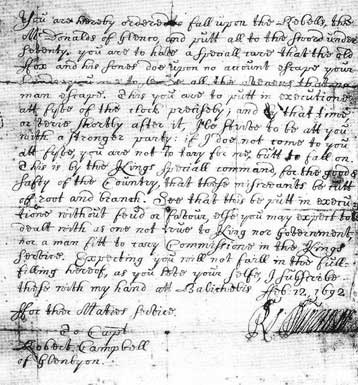
Glenlyon and his troops were entertained by MacIan and his people for over a week. On the 12th of February, the order of "fire and sword" (to put everyone to death and burn everything) was handed down to Arglye's regiment and they were ordered to proceed to Glencoe so as to reach the post by five o'clock the following morning. The instructions reached Glenlyon to "all upon the MacDonald's precisely at five o'clock the following morning and put all the sword under 70 years of age".

After dinner and a card game with the sons of the chieftain, Glenlyon wished them a goodnight and even accepted an invitation by MacIan to dine with him the following day. MacIan and his sons retired at their usual hour, but early in the morning, one of the sons hearing voices about his house, grew alarmed and, jumping out of bed, went to Glenlyon's quarters to ascertain the cause of the unusual bustle which had interrupted is sleep. He found the soldiers all in motion and inquired of Glenlyon the object of these preparations. Glenlyon pretended that his purpose was to march against some of Glengarry's men and explained if he had intended any harm to the clan, he would have provided for the safety of his niece and her husband.

Satisfied, young MacDonald retired to his house, but had not been long in bed when he was awakened by his servant informing him of the approach of a party of men towards the house. Seeing this company of 20 or so soldiers with muskets and fixed bayonets, he fled to a hill in the neighborhood where he was later joined by his brother who had escaped after being awakened by a servant.   
The massacre commenced at five o'clock in the morning February 13 at three different places at once. Glenlyon undertook to butcher his own hospitable landlord and other inhabitants at Inverriggan. MacIan was shot while rising to receive what he thought were visitors and fell into the arms of his wife. The lady herself was stripped naked and treated so cruelly (the soldiers pulled her rings off with their teeth), that she died the next morning.

A third party fired upon nine men in a house sitting before a fire. One of these men had a protection in his pocket from Colonel Hill.

There were persons dragged from their beds and murdered in all parts of the glen. In all, only 38 persons out of 200 were slaughtered. They burned the houses and carried off the cattle, thus preventing the inhabitants from returning to the Glen. Those that had fled, including elderly matrons, women with child, and mothers with infants at their breasts, followed by children were left to try to find their way through the snow covered mountains, many perishing from cold, hunger and fatigue.

It all aroused a great outcry in Scotland, even in the Lowlands where Highlanders were scorned. The authorities realized that they had gone too far and Stair ( the King's advisor) had to retire from the scene for a while, but he was never punished and eventually was promoted to the Earl of Stair. King William himself could not escape responsibility for he had given the orders of fire and sword on Stair's advice. Nothing was ever done in the way of punishment to anyone involved in the incident. However the Earl of Breadalbane was found guilty of High treason and he spent a few days imprisoned in Edinburgh Castle. The entire incident was hushed up and is now a part of history that is regarded as a sad and unexplainable blunder. It however has made both those that were the perpetrators and the victims forever famous. Even today, after 314 years, in some parts of Scotland it is not wise to admit you might be a Campbell especially around Glencoe.

It was not so much the deed itself that brings about the continuing hatred, it was the way it was done. According to Scottish hospitality one did not wage war against the one that cared for you. If you had a grievance with your host, you left and then came back to fight with honor.

"We (the Scots) are a race of leaders. But you can't all be leaders, therefore, we tend to fight one another." - Nigel Tranter
Highland Massacre at Glencoe By Robert Gunn
NOTE:PLEASE READ - This is a perspective. - This is a very sensitive subject to Scots. Whilst I do not apologise for the essay I do understand the feelings of modern day Campbells. I do NOT hold (or blame) present day Campbells responsible for the actions of their forefathers, nor should anyone else. I am sorry if anyone takes this personally, it is simply history. I stand by this account and the history within. Now for the story......

Preface and Historical Background
Scotland was divided by its geography: to the Southeast lay the Lowland farms, big cities and the Border country. To the North lay the Highlands and Isles. Quite unfairly for the people that gave Scotland its name - the Scots (of the Irish Scotti), not everybody saw the Gaels as civilised - especially the Lowlanders. But it was from the Lowlands that from the 11th century onwards that Scotland would be ruled. This would serve to differentiate the Scottish people throughout most of their history.
Whilst the Highlanders and Islanders were seen as wild and uncivilised by the Lowlands and the English, the Highlanders saw their Lowland counterparts as simply another type of English. These differences would be fuel to the upcoming heated and controversial subject of Glencoe.
While the Lowlands adopted the English language and customs for various, complicated reasons, the Highlander largely spoke Gaelic and became increasingly seen as 'alien' and barbaric. A quote from King James VI of Scotland is a typical example:
"As for the Highlands, I shortly comprehend them all in two sorts of people: the one that dwelleth in our mainland that are barbarous and yet mixed with some sort of civility. The other that dwelleth in the Isles and are all utterly barbarous, think no more of an goat, than wolves and wild boars."
This lack of understanding would lead the Lords of the Isles (The clan Donald - MacDonald) into more and more trouble with the kings.
With no central authority in the Highlands a strong Chief was the only protection and the only law a clansman could turn to when in need. Nothing was held with higher value of this unwritten law, than the hospitality of a chief to his guests. This breech of highland hospitality plays a vital part in our understanding of the massacre of Glencoe.
Reiving (cattle rustling) had become a way of life of the Highlanders. The obtaining of cattle and other animals from another clan (reiving) was an understood (if impractical) and accepted way of life and did not make the clans who participated in it "thieves" anymore than a Sioux or an Apache brave in the Western US. The young clan Chief could prove his worth with a successful raid into hostile territory. Although this led to may conflicts, 'reiving' of cattle had been done for centuries and by almost all clans.
With this in mind we are nearly set for the story of the massacre at Glencoe. Of all the bloody incidents that stained the history of Highland clans, one above all, still has the power to shock, after more than 300 years.

The story of the MacDonalds of Glencoe thus begins in 1692. The MacIan MacDonalds were active in many unsavory affairs including support for Montrose in his many campaigns for the Jacobite cause, and the reiving of cattle from lands to the south - Campbell lands in Argyll. In the eyes of the southern people, they were a clan to make an example of. They MacIan MacDonald's were a small clan of no more than 300-400 strong. They'd lived in these lands for centuries and felt themselves the owners of the area.
In February of 1692, under government orders, a regiment of government soldiers from the Duke of Argyll's (Campbell) militia, came into the glen. Most of the troops were Campbells, or septs of the Campbells [James Hunter, Author/historian], but the strict code of hospitality required the MacDonald Chief, and his people, to give food and shelter to the unwelcomed guests. But as will be seen, this was no social visit.

Tragedy at Glen Coe (Glencoe)
In 1688, William of Orange the Dutch Prince, invited to Britain as King, for fear of the Stuarts, asked the English Parliament to oust the current King James VII of Scotland and James II of England because of James II's own rule that stated: "...attending a Covenanting (a secret meeting of Scots Presbyterians) act of worship was a capital crime", and many Scots Presbyterians paid the penalty, losing any love for James II they might have had. James II alienated all the peoples support he depended on, and he was ousted from the throne of England and Scotland in 1688, the last of the Stewart Kings.
He had been ousted, primarily, by William of Orange, a Dutchman invited to England and with the strong of encouragement and support of the Parliament. Whilst James II accepted his exile, others did not, and they fought back. The intensely brutal battles went back and forth. Scots Protestants fought English Protestants, both fought the Catholics.
Many Highlanders, who still had Catholic and/or Episcopalian beliefs, or at least empathy for their Irish cousins, fought with zeal against the English church and especially against the Lowland Scots Covenanters (later Presbyterians). Here is an eyewitness account of the Highland anger from battle of Killecrankie: "The regular (English and Lowland Scots governmental British) troops followed their routine of firing a musket volley and then fixing bayonets to charge. They had no time to fix the bayonets before the wild Highlanders were on them, screaming and flailing their Claymores" (6 foot 2-handed sword).
"General MacKay's , (British) men were killed in the hundreds"
The fierce battles went on.......................

Scotland didn't quite settle down to peaceful times, despite their victories - old divisions to precarious to be thrown out. Loyal or not to William of Orange, they had a bitter sense of grievance against him. Many Scots objected to the intolerance, anti-Presbyterian intolerance, of the Stewart (or Stuart in it's French spelling) Kings. They were almost equally outraged by the tolerance of William. This is somewhat typical of the confusing Scottish/English relationship.
Some Scottish legends claim William of Orange as the valiant champion of the Protestant cause against the Catholics. (Of course Highland opinions on the matter varied considerably). The "Protestant Champion" King William did rid Britain of a Catholic King -- James II and VII (of England and Scotland respectively). It was, in fact, just a political manoeuver against James II, not a religious one. William of Orange was on friendy terms with the Pope -- had Catholics in his army in highest ranking areas, and more. But, inevitably, history still sees William of Orange, as the patron saint of hardline Protestantism. It simply wasn't that simple; It simply wasn't the truth.
Thankfully, at least by all appearances, the religious wars of fury, hate and blood came slowly to a halt. With religious peace or tolerance, came the need for political peace, particularly among the Highlanders, who were largely cut off from Lowland society, and who included many subjects still loyal to the deposed King James II and the different faith that many Highlanders, though not all, still clung to -- in a "Scottish way" That, is typical of Highlander stubborness and determination.

The Glencoe Tragedy
William of Orange was seen as a hero to many (mostly Lowland) Scots and Englishmen; truth was, he was simply not very interested in Scotland. His minister for Scotland , John Dalrymple "Master of Stair", who took charge of the Royal Ordinance that all Highland Chiefs of Highland clans must abandon the old Stuart (Stewart) loyalty and swear fealty to William of Orange.
Highlanders swearing loyalty or fealty to any King is a diffucult thing to accomplish.During a time when a large portion of Scots Highlanders were still Catholic, due mostly to the "Auld Alliance" with Catholic France. To swear loyalty to the anti-Catholic, anti-Stuart , anti-Scots Highlander; anti-French (Scots Ally) and on top of it all, swear to an English King from Holland! Not even an English born English king, was hard to understand.
The English King, William of Orange and his advisors, felt it was "necessary" to deal with the troublesome Highland Scots. The Scots had been in rebellion over King James II & VII being exiled in France, and these rebellions led to the Jacobite rebellions against England. Note that the Jacobite rebellions also included many Lowland families as well (such as the Grahams), but they were initially supported only by Highland clans. So the King of England, William of Orange sent his man, Dalyrmple, known as "Master of Stair of Scottish Affairs", to force the Highland Chiefs to swear an oath of loyalty to William and abandon exiled James II & VII. But the Stair (Dalyrmple) had a personal grudge against a small sect of MacIans of the Clan MacDonald, for participating in the rebellions and, he claimed, cattle reiving (stealing). The real motive seems to have been one of support for the Jacobites (under Dundee, who fought for the Stuart cause) ; a Catholic Stuart king.
Worse still, there was a 'closing date' (deadline) for the oath, on New Years day, 1692, and what would become of this dictatorial ordinance was to be a legendary bloodbath that tainted William's reputation for all Scots and many English.
Many argue, even today, that the following incident was "minor" in comparison to other atrocities in Scots/English history. In terms of numbers, yes, it is minor. But I shall let you, the reader, decide whether or not this account of Glencoe sounds minor to you .....the eyes of a first time reader of this tragedy, rarely lie to the individual.
Having no real choice, the Highland Clan Chiefs did what was demanded. However, one minor chieftain MacIan of Clan MacDonald, got it wrong. He took his oath to Fort William, (as he claimed he was told -- and there is truly no reason to doubt his claim) , but upon arrival at Fort William, he was told that the proper place to take his oath was Inverarary.
There is ample evidence that this was done by Dalyrmple to be sure the clan Chief would arrive late. So, in the deep of cold mid-winter, he went there but arrived a few days late due to the misdirection and deep bitterly cold winter weather. The sheriff who was to receive his fealty and oath, was also late -- later even than the Chief. When the sheriff arrived, he accepted MacIans oath. What no one suspected was that the "Master of Stair" , John Dalyrmple, had a personal grudge against the MacDonalds for their participation in the cattle reiving and supporting Jacobite causes, (the word Jacobite being a form of the word James from Jacob), but most of all, because they were supporters of exiled James II and considered Papists. William of Orange's man, John Dalyrmple (Master of Stair), took the view that the declaration (oath) was invalid because it was two (2) days late, and ordered a Campbell regiment to do a "job" for him. This Campbell was Robert Campbell of Glenlyon (Glen Lyon). He was to extirpate the MacDonald's that Dalyrmple detested.
John Dalrymple (1648-1707) was a judge. His father had held the position of first Viscount Stair (earl), a succesful Jurist and defender of Covenantor values. John, the son, had always been sensitive to the fact that his father had resigned his post rather than take the "Test Oath" and John had come to friendly terms with James II, the Catholic Stewart King, early on in his career. When James was forced into exile, and Lowland and English hate of the Catholic Stewarts had grown strong, [Collin's Scotland, 1996], Dalrymple had a switch of faiths. Like his father, he was an able but unscrupulous man. He was appointed by William of Orange to the posts of Lord Advocate and then Joint Secretary of State (over Scotland) with Melville in 1691. He was given the responsibility of controlling the rebellious Highland Jacobites, and lacking the troops to overcome them initially, he put into action, with his Campbell conspirators, and with the blessing of King William, a sinister plot. Sensitive to accusations by protestants that as a previous supporter of Catholic exile James, he still had Catholic leanings, and sharing with many other Lowlander Scots a fear and loathing of Highland clans, he determined to make an example of the "worst of the worst" of clans - the small reiving, and Jacobite supporting clan of MacIan MacDonalds.
The clan Campbell had been working with the King's for almost two centuries, policing other clans in the name of the Throne; reporting other clans to the king; massacring rival clans ( i.e. the Lamonts) and taking their lands as their own; and ocassionally wiping out clans the Scottish and later the British government didn't want to deal with any longer. The Campbell's were not always willing pawns of the English. The Campbells, such a proud and powerful clan - in the days of Wallace and Bruce and over two centuries after Bannockburn (1314) , had aligned themselves solely with the Scottish Kings against, initially, the Lords of the Isles who saw themselves as independent. This eventually led to alignment or loyalty to the British - (Union of the Crowns, 1603, Union of Parliaments 1707).
They became the eyes and ears on Highland activity for the government -- they turned traitor to Highland Scotland and with their continual feuds with the MacDonalds (amongst others) they were more than willing to do this "job" for the government forces.
The horric incident that would scar King William of Orange's and the Campbell's names occured in 1692.
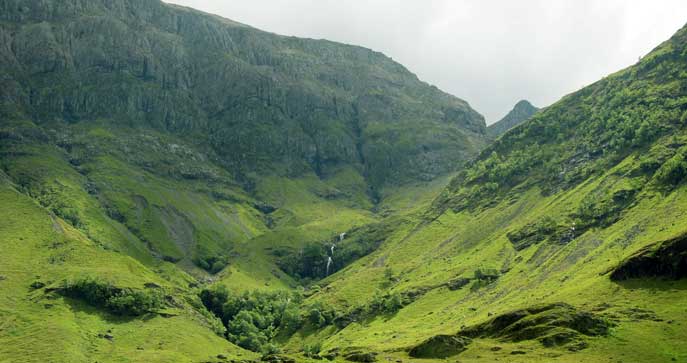
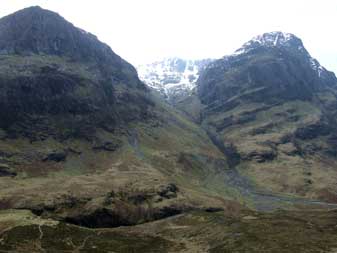
The place was the valley Glencoe, which has a bleak and forbidding atmosphere even in bright sunlight, (and it is still that way today), as if the hills remember black treachery and blood.
Glencoe is where the little community of the MacIan's, of small sect of the MacDonald clan, lived. The MacIan MacDonald's were no angels having raided cattle of their southern neighbours before. But their biggest crime, in the eyes of the Protestant British Government, was being Jacobite sympathisers. In early winter, 2 February 1692, the small clan of the MacIan of MacDonald's, generally, simply referred to as MacDonalds, were visited by the detachment of Campbells (the majority of the soldiers were Campbells by marriage or sept - [from James Hunter, "Battle of the Highland Clans", Scottish historian in Scotland], and their Highland mercenaries. From all accounts, they were received with hospitality. The Chieftain's were related by marriage. The Campbells and their troops stayed for nearly two weeks and were on friendly terms with their hosts.
At this time it needs to be pointed out that the regiment sent to deal with the MacDonalds were not only of Campbell members or clans. They had various names in their ranks from all over Scotland, but it was clear they were under the direction of the Campell commander, Robert Campbell, and he was under clear direction of Dalrymple - thus also William of Orange. To look at this incident as a clan feud or a Clan Campbell versus the Clan MacDonald would be incorrect and misleading.
Despite the fact that they did and were often at odds with each other, and did indeed feud, this was a military operation of ruthless severity ordered by British government stooges. I have referred several times in the following article to the perpetrators of the barbarous crimes as the Clan Campbell, which is not 100% factual, but almost all Scottish experts that write on Glencoe, including the highly respected authors John Prebble, Fitzroy Maclean, Tom Steele, etc, refer to the perpetrators as members of Clan Campbell because (1) a majority of the garrison were from the various branches of the Campbell clans (and septs), and (2) the real Campbell involvement was the Earl of Breadalbane who was involved from the outset in the planning and organisation of the massacre. Also involved in this planning was the Earl of Argyll (Campbell). If I could in good conscience call the guilty parties by some other name -- I would. But the fact remains it was a major incident in Campbell and Scottish history. To back up this claim, one needs only to look at the conspirators of the planned massacre, who after Dalrymple and Duncanson, were heads of the Breadalbane and Argyll branches of the Campbell clans in confederation with the Master of Stair, and his boss, King William of Orange.
A quote from Dalyrmple, the main organiser, shows he feelings regarding the MacDonald's:
"[The] Glencoe [Chief] had not taken the oath [he did but late] , at which I rejoice! It will be a proper vindication of public justice to extripate that sect of thieves. It must quietly done. Let it be secret, and sudden." -- Master of Stair, Dalyrmple.
At least by all appearances, the visit from the Campbells was a good one. There was much drinking, feasting, dancing and harmony. The guests stayed for two weeks.
But in the still dark early morning, 13 February 1692, the guests arose and systematically set about viciously murdering their hosts. Women and children were not spared.
The Campbell's orders from King William's man in Scotland, John Dalyrmple --- "Master of Stair" , were quite brutal and clear. The orders were snt to Major Duncanson who relayed them to Robert Campbell of Glenlyon and carried the kings personal authority in a sealed order.
The Note read such:

To Captain Robert Campbell of Glenlyon
' For Their Majesties' Service'


(In old English, exactly as it appeared)

Sir, You are hereby ordered to fall upon the rebels, the M'Donalds, of Glencoe and putt all to the sword under seventy. You are to have special care that the old fox and his sons doe upon no account escape your hands.

You are to secure all the avenues, that no man may escape. This you are to putt in execution at five o'clock in the morning precisely, and by that time, or very shortly after it, I'll strive to be att you with a stronger party. If I doe not come to you att five, you are not to tarry for me, but to fall on.

This is by the King's special command, for the good of the country, that these miscreants be cutt off root and branch. See that this be putt in execution without feud or favour, else you may expect to be treated as not true to the king's government, nor a man fitt to carry a commission in the king's service. Expecting you will not faill in the fulfilling hereof as you love yourself, I subscribe these with my hand.

(John Dalyrmple) via Duncanson.
The "old fox" was the clan Chief of the MacDonalds. The "king" referred to was William, Prince of Orange. This writer isn't trying to make a judgement on either clan, both had their heroes and demons. All clans did. But the Campbells of Breadalbane, led by Sir Robert Campbell and with his men, stayed with the gracious and generous MacDonalds of Glencoe for nearly two weeks, drinking, making hay among other things, generally having a spontaneous ceilidh (kâ´lê), [an Irish or Scottish social gathering with traditional music, dancing, and storytelling]. Then suddenly, without provocation or warning, the Campbell guests stirred into action at five o'clock in the morning. They set about slaughtering all the defenseless, unarmed and helpless MacDonald's they could find, in the darkness of a black early morning of despair.
In a sudden snowstorm, many of the shocked MacDonalds escaped into the pitiless bitter cold snow and many perished from exposure. About forty members of the small clan of Ian of MacDonald , including Ian, the Chief and his family were ruthlessly slain in cold blood. Among the foully murdered were also two children and two women.
After killing the MacDonald Chief, the murderers had ruffed up and possibly violated his wife, and in the process a soldier bit the finger off her hand to get her gold ring, because she would not give it up to them. She was left to die in the cold. A child of six, trying to hide behind a soldier, was bayoneted without remorse. We are often told of the 38 that died at the hand of the Campbell regiment, but as many as one hundred more may have died of exposure to the snow and cold after fleeing from their would-be murderers. The numbers could be as high as 100 dead. [Battle of the Clans.]

The Proof is in the Conspirators.
However, some did survive, despite serious injuries. The Massacre of Glencoe enraged Scotland with its treachery and lead to years of feuding in the Highlands. England's King William III's agent John Dalrymple, 44, Earl of Stair, suppressed news of the oath taken six days late, by Ian MacDonald, chieftain of the MacDonald Clan at Glencoe, and conspired against MacDonald with Archibald [Campbell] Argyll, 41, and with John Campbell, 57, first Earl of Breadalbane.
The actual massacre was led by Sir Robert Campbell of Glenlyon. If ever more proof were needed, the above mentioned names and their involvement in this slaughter, is an indictment itself.
Just a quick glance at the above named conspirators and the man who led the fatal expedition, Sir Robert Campbell of Glenlyon, a drunken aging soldier who had had run-ins with branches of the MacDonalds previously. It is clear from the names, that even if the whole of the Clan Campbell was not involved, enough of the leadership of the clan(s) were, that the blame rightfully does fall on their shoulders despite their denial of doing anything wrong, to this very day. The claim of "We were just following orders" or "it was stricltly a military operation" has a fascist sound that does not let the clan off the hook so easily.
This atrocious slaughter carried out upon the a small clan of MacIan MacDonalds, was initiated by the King of England himself, despite his denial, his man, John Dalyrmple (Master or Earl of Stair) and the Campbell conspirators proved beyond any doubt to the Highlanders, that England and portions of Lowland Scotland had been behind the slaughter. At least the leaders of these areas.
It isn't the number of casualties that is so shocking, rather, the manner of it, and the treachery of it. The MacDonalds opened their doors of rather modest homes, and generously let the Campbells inside their abodes. The Campbells said they were lost in the snow and asked to stay for a while, warm themselves and rest. Graciously, the MacDonald's agreed to let all the Campbell men and their Highland allies into their humble dwellings, trusting in God, that they were doing the right thing. They fed them their winter preserved meat, their wine, ale, friendship and by some accounts blossoming love among the younger folk.
The role of the Goverment and the monarch were debated for a long time. As stated in the Encyclopedia in the late 18th century:
"In various acts of the privy council of Scotland, the clan Gregor is denounced (proscribed) in the above terms, and was visited with all the terrors of "fire and sword". "their habitations were destroyed. They were hunted down like wild beasts. Their very name was proscribed." We have already referred to, in its proper place, a mandate from King James V in 1583, against the clan Chattan, in which he charges his lieges to invade the clan "to their utter destruction by slaughter, burning, drowning, and otherways; and leave no creature living of that clan, except priests, women and bairns."
Less than one hundred years later, the Highlanders was still be dehumanished and villified. Even Captain Burt, in the beginning of the next century writes of the Highlanders as if they were an interesting race of semi-barbarians, many of whom would cut a man's throat for the mere sake of keeping their hands in practice.
Far from having regret at his involment in the massacre, Dalrymple stated this after the fact:
"All I regret is, that any of the sort got away; and there is a necessity to prosecute them to the utmost." Again, writing to Colonel Hill in April of the same year, he tells him that "as for the people of Glencoe, when you do your duty in a thing so necessary to rid the country of thieving, you need not trouble yourself to take the pains to vindicate yourself. When you do right, you need fear nobody. All that can be said is, that, in the execution, it was neither so full nor so fair as might have been." -- From a letter of 5 March, 1692, after referring to the universal talk in London about the transaction.
Had the clan been proceeded against in open and legitimate warfare, resulting in its utter extinction, the affair might have occupied no more than a short paragraph in this and other histories. There can be no doubt that what gives the deed its nefarious stamp, is the fiendishly deliberate and deceitful way in which it was accomplished, in violation of laws of hospitality which are respected even by cut-throat Arabs. And after all it was a blunder. (Encyclopedia Britannica, 1785).

Punishment?
No active measures in the way of punishing either principals or subordinates, however, were taken in consequence of the findings of the commission and the recommendations of parliament, except that Breadalbane, who they found had laid himself open to a charge of high treason, was imprisoned for a few days in Edinburgh castle.

A curious and interesting incident came out during the sitting of the commission, tending to show that Breadalbane was conscious of a very large share of guilt, and was fully aware of the heinous and nefarious character of the bloody transaction.

Some days after the slaughter, a person sent by Breadalbane's steward waited upon Glencoe's sons, and told them that if they would declare that his lordship had no concern in the slaughter, they might be assured that the earl would procure their "remission and restitution."
The claim has been made that even the drunken Robert Campbell of Glenlyon died honourably in battle. But in fact he died a natural death - or as natural a death as can be had from liver failure due to toxicity from alcohol.
Glencoe is known by most people now, as the site of the massacre.
Glencoe was once was a quiet, serene place. The actions of the Campbells involved, as well as the other men fighting with them, the involvement of Breadalbane, Argyll and Dalrymple is inexcusable, even by the often brutal standards of the day.
The late Campbell Chief tried to explain the massacre .....(paraphrasing) "...We did what we were supposed to do. If you receive an order from a superior commander -- you do it, and we did.....we were just obeying orders."
That type of black-hearted remark is exactly what keeps some names, forever cast in a dark evil world, full of inhuman things. A world of disrespect, total irregard or indifference to innocent human life. It makes for nauseous reading, but it is part of Scotland's history, therefore, a valid topic. It is even more so because the current attitude amongst the clans involved now want to bury the issue by claiming it was just a minor incident and that only 38 people really died. True, only 38 died ( by the hands of the Campbell soldiers - more by exposure) because they botched the operation and many members of the clan did escape - else the death tally would have run over two hundred. As many as 50 - 100 did die of exposure, no one is quite certain of the number. But add that to the 38 killed outright, and over 100 were killed.
Ironically, there is now a "Glen Coe Centre" which was funded, for the most part by the Clans Campbell and MacDonald to both put aside the old image of brutal slaughter (bad for tourism and bad for the clans' images) and to make a hefty profit from unsuspecting Scottish descendants coming to visit only to be told it was just a minor incident and that the past is the past now and we should just forget and move on. I had a member of Clan Campbell (a high ranking one) write to me from my website asking I take down the story as it was totally inaccurate. I challenged him to tell me the "real" events. He was unable to deny the clans involvement in the end but insisted it was strictly a military maneuver, that it wasn't a personal bloodfeud and it was very long ago.
I suppose the fact it was a military operation to annihilate innocent civlians under direct orders from a British king is alright by some. But not to this author - never. I will continue to write the truth of Scottish history and sometimes that includes the ugly facts such as Glencoe.
This conclusion is supported by a quote from Scottish historian and Author, James Hunter, who recently said:
"What particularly distinguishes this act from others, and why it resonates today, was the absolute betrayal of the [tradition of] Highland hopitality by the Campbell forces. And the other was the hand of the government in it - the government had ordred it. It was a genocidal act." -- James Hunter, Scottish historian
The black treachery of this horrible incident has inspired many songs and stories. I have included one of my favourite Scottish songs -- originally known to this author as the "MacDonald's Lament" or now more commonly known as "Massacre at Glencoe" or "Glencoe".
These are the words to the song "Massacre at Glencoe", sum up the way many still feel about the horribe deed. These words are below:
Members of Clan Campbell, under orders from King of England - William of Orange's men, were sent to kill all of a small family of MacDonald's under the age of seventy. No one else was to be spared. The Campbells and allies, carried out this horrific act after spending nearly two weeks living at the modest MacDonald's home in Glencoe.

These are the words to a song, immortalizing the black deed that some members, under Robert Campbell of Clan Campbell of Breadlabane, carried out on the helpless MacDonalds. The year was 1692.

A Scottish lament
{ CHORUS }
Oh cruel as the snow that sweeps Glencoe,
and covers the graves o' Donald (Donnell),
Oh cruel was the foe that raped Glencoe,
and murdered the house of MacDonald.

They came in a blizzard, we offered them heat,
a roof for their heads, dry shoes for their feet,
we wined them and dined them, they ate all our meat,
and they slept in the house of MacDonald.

Repeat Chorus ----

They came from fort William, with murder in mind,
the Campbell had orders, King William had signed,
put all to the sword, these words underlined,
leave no one alive called MacDonald.

Repeat Chorus ----

They came in the night, while our men were asleep,
this band of Argylls, through snow soft and deep,
like murdering foxes, among helpless sheep,
they slaughtered the house of MacDonald.

Repeat Chorus ----

Some died in their beds, at the hands of the foe,
some fled in the night, and were lost in the snow,
some lived to accuse him, who struck the first blow,
but gone was the house of MacDonald.

Oh cruel as the snow that sweeps Glencoe,
and covers the graves o' Donald,
Oh cruel was the foe that raped Glencoe,
and murdered the house of MacDonald,
and murdered the house of MacDonald.

Words: J. McLean

Fortunately some MacDonalds escaped to tell of the slaughter. Yet before we condemn the Campbells for this horrifying act, this is the same clan, several centuries earlier that helped an outlaw named Robert the Bruce, who was hiding from the English and enemy Scots alike, shortly after being made king of Scotland.
It is easy to look at the Highland Clans now, and make judgements against or for them. It was not so black and white then. Of course, what the Campbells did was terrible, and for that single act, they are remembered by many, many Scots for this incident, in a bad light.
No present day person is responsible for any crime against the Glencoe MacDonalds. Nor are they responsible for the crimes of their distant relatives. I am simply telling history, on this ONE article, from a Scottish Highland perspective. Not all Scottish history is full of proud moments and ALL clans have their ugly sides. This one stands out because of the nature of the crime, and the fact that it was endorsed, nay, encouraged by the king himself.
RM GUNN, MA Author, Medieval Historian

This article may be freely shared and distributed for use by various clan organsiations and Scottish societies, with permission and consent of the author so long as the link to the author's page is included.

Back to Top