Showing posts with label gmo's. Show all posts

Wednesday, February 29, 2012

Why is the Gates foundation investing in GM giant Monsanto?

The Bill and Melinda Gates Foundation's investments in Monsanto and Cargill have come under heavy criticism. Is it time for the foundation to come clean on its visions for agriculture in developing countries?

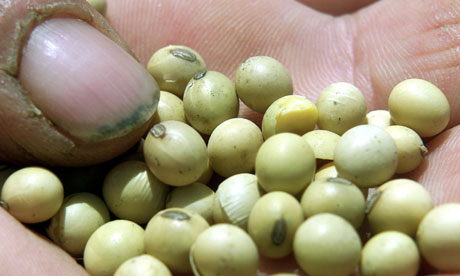
MDG : Mozambique gm soya by Cargill and Monsoanto
A Romanian farmer shows genetically modified soybeans in the village of Varasti. Photograph: Reuters
The Bill and Melinda Gates Foundation, which is sponsoring the Guardian's Global development site is being heavily criticised in Africa and the US for getting into bed not just with notorious GM companyMonsanto, but also with agribusiness commodity giant Cargill.
Trouble began when a US financial website published the foundation's annual investment portfolio, which showed it had bought 500,000 Monsanto shares worth around $23m. This was a substantial increase in the last six months and while it is just small change for Bill and Melinda, it has been enough to let loose their fiercest critics.
Seattle-based Agra Watch - a project of the Community Alliance for Global Justice - was outraged. "Monsanto has a history of blatant disregard for the interests and well being of small farmers around the world… [This] casts serious doubt on the foundation's heavy funding of agricultural development in Africa," it thundered.
But it got worse. South Africa-based watchdog the African Centre for Biosafety then found that the foundation was teaming up with Cargill in a $10m project to "develop the soya value chain" in Mozambique and elsewhere. Who knows what this corporate-speak really means, but in all probability it heralds the big time introduction of GM soya in southern Africa.
The two incidents raise a host of questions for the foundation. Few people doubt that GM has a place in Africa, but is Gates being hopelessly naïve by backing two of the world's most aggressive agri-giants? There is, after all, genuine concern at governmental and community level that the United State's model of extensive hi-tech farming is inappropriate for most of Africa and should not be foist on the poorest farmers in the name of "feeding the world".
The fact is that Cargill is a faceless agri-giant that controls most of the world's food commodities and Monsanto has been blundering around poor Asian countries for a decade giving itself and the US a lousy name for corporate bullying. Does Gates know it is in danger of being caught up in their reputations, or does the foundation actually share their corporate vision of farming and intend to work with them more in future?
The foundation has never been upfront about its vision for agriculture in the world's poorest countries, nor the role of controversial technologies like GM. But perhaps it could start the debate here?
In the meantime, it could tell us how many of its senior agricultural staff used to work for Monsanto or Cargill?

Bill Gates, Monsanto, and Eugenics

How one of the world's wealthiest men is actively promoting a corporate takeover of global agriculture


(NaturalNews) 

After it was exposed that the Bill & Melinda Gates Foundation, the philanthropic brainchild of Microsoft founder Bill Gates, purchased 500,000 shares in Monsanto back in 2010 valued at more than $23 million, it became abundantly clear that this so-called benevolent charity is up to something other than eradicating disease and feeding the world's poor (http://www.guardian.co.uk). It turns out that the Gates family legacy has long been one of trying to dominate and control the world's systems, including in the areas of technology, medicine, and now agriculture.

The Gates Foundation, aka the tax-exempt Gates Family Trust, is currently in the process of spending billions of dollars in the name of humanitarianism to establish a global food monopoly dominated by genetically-modified (GM) crops and seeds. And based on the Gates family's history of involvement in world affairs, it appears that one of its main goals besides simply establishing corporate control of the world's food supply is to reduce the world's population by a significant amount in the process.

William H. Gates Sr., former head of eugenics group Planned Parenthood

Bill Gates' father, William H. Gates Sr., has long been involved with the eugenics group Planned Parenthood, a rebranded organization birthed out of the American Eugenics Society. In a 2003 interview with PBS' Bill Moyers, Bill Gates admitted that his father used to be the head of Planned Parenthood, which was founded on the concept that most human beings are just "reckless breeders" and "human weeds" in need of culling (http://www.pbs.org/now/transcript/transcript_gates.html).

Gates also admitted during the interview that his family's involvement in reproductive issues throughout the years has been extensive, referencing his own prior adherence to the beliefs of eugenicist Thomas Robert Malthus, who believed that populations of the world need to be controlled through reproductive restrictions. Though Gates claims he now holds a different view, it appears as though his foundation's initiatives are just a modified Malthusian approach that much more discreetly reduces populations through vaccines and GMOs (http://en.wikipedia.org/wiki/Thomas_Robert_Malthus).

Gates Foundation has invested heavily in converting Asian, African agricultural systems to GMOs

William Gates Sr.'s association with Planned Parenthood and continued influence in the realm of "population and reproductive health" is significant because Gates Sr. is co-chair of the Bill & Melinda Gates Foundation (http://www.gatesfoundation.org/leadership/Pages/william-gates-sr.aspx). This long-time eugenicist "guides the vision and strategic direction" of the Gates Foundation, which is currently heavily focused on forcing GMOs on Africa via its financing of the Alliance for a Green Revolution in Africa (AGRA).

The Gates Foundation has admittedly given at least $264.5 million in grant commitments to AGRA (www.gatesfoundation.org/about/Documents/BMGFFactSheet.pdf), and also reportedly hired Dr. Robert Horsch, a former Monsanto executive for 25 years who developed Roundup, to head up AGRA back in 2006. According to a report published in La Via Campesina back in 2010, 70 percent of AGRA's grantees in Kenya work directly with Monsanto, and nearly 80 percent of the Gates Foundation funding is devoted to biotechnology (http://www.organicconsumers.org/articles/article_21606.cfm).

The same report explains that the Gates Foundation pledged $880 million in April 2010 to create the Global Agriculture and Food Security Program (GAFSP), which is a heavy promoter of GMOs. GAFSP, of course, was responsible for providing $35 million in "aid" to earthquake-shattered Haiti to be used for implementing GMO agricultural systems and technologies.

Back in 2003, the Gates Foundation invested $25 million in "GM (genetically modified) research to develop vitamin and protein-enriched seeds for the world's poor," a move that many international charities and farmers groups vehemently opposed (http://healthfreedoms.org). And in 2008, the Gates Foundation awarded $26.8 million to Cornell University to research GM wheat, which is the next major food crop in the crosshairs of Monsanto's GM food crop pipeline (http://www.organicconsumers.org/articles/article_21606.cfm).

If you control agriculture, you control the populations of the world

The Gates Foundation's ties with Monsanto and corporate agriculture in general speak volumes about its real agenda, which is to create a monopolistic system of world control in every area of human life. Vaccines, pharmaceuticals, GMOs, reproductive control, weather manipulation, global warming -- these and many other points of entry are the means by which the Gates Foundation is making great strides to control the world by pretending to help improve and save it.

Rather than promote real food sovereignty and address the underlying political and economic issues that breed poverty, Gates and Co. has instead embraced the promotion of corporately-owned and controlled agriculture and medicine paradigms that will only further enslave the world's most impoverished. It is abundantly evident that GMOs have ravished already-impoverished people groups by destroying their native agricultural systems, as has been seen in India (http://www.naturalnews.com/030913_Monsanto_suicides.html).

Some may say Gates' endeavors are all about the money, while others may say they are about power and control. Perhaps it is a combination of both, where Gates is still in the business of promoting his own commercial investments, which includes buying shares in Monsanto while simultaneously investing in programs to promote Monsanto.

Whatever the case may be, there is simply no denying that Gates now has a direct interest in seeing Monsanto succeed in spreading GMOs around the world. And since Gates is openly facilitating Monsanto's growth into new markets through his "humanitarian" efforts, it is clear that the Gates family is in bed with Monsanto.

"Although Bill Gates might try to say that the Foundation is not linked to his business, all it proves is the opposite: most of their donations end up favoring the commercial investments of the tycoon, not really "donating" anything, but instead of paying taxes to state coffers, he invests his profits in where it is favorable to him economically, including propaganda from their supposed good intentions," wrote Silvia Ribeiro in the Mexican news source La Jornada back in 2010.

"On the contrary, their 'donations' finance projects as destructive as geoengineering or replacement of natural community medicines for high-tech patented medicines in the poorest areas of the world ... Gates is also engaged in trying to destroy rural farming worldwide, mainly through the 'Alliance for a Green Revolution in Africa' (AGRA). It works as a Trojan horse to deprive poor African farmers of their traditional seeds, replacing them with the seeds of their companies first, finally by genetically modified (GM)."

Sources for this article include:

http://www.guardian.co.uk

http://www.seattleglobaljustice.org

http://english.pravda.ru

http://www.organicconsumers.org/articles/article_21606.cfm

http://en.wikipedia.org/wiki/American_Eugenics_Society

http://www.naturalnews.com/033148_seed_companies_Monsanto.html

Learn more: http://www.naturalnews.com/035105_Bill_Gates_Monsanto_eugenics.html#ixzz1nowRh3Gb

Consolidation of seed companies dominates world food supply


Consolidation of seed companies leading to corporate domination of world food supply

(NaturalNews)

Throughout the history of agriculture across the globe, farming has always been a diversified sector of the economy. Small, self-sustaining, family farms were the order of the day in most cultures. Even as small farms grew larger and more specialized over time, many of them still saved seeds or purchased them from other farmers, which kept control of farming in the hands of the people.

But today everything has changed, as large chemical and agribusiness firms have acquired or merged with seed companies and other agricultural input companies. They have successfully gained a foothold on genetically-modified (GM) crops with transgenic traits.

These primary factors and several others have facilitated a crescendo towards the global domination of agriculture by corporations, and thus the world's food supply.

The dismal state in which we find ourselves today did not come overnight, of course, but it did pick up rapid speed after the introduction of GM crops in the mid-1990s. Since that time, multinational corporations like Monsanto, DuPont, and Syngenta have seized a significant amount of control over the global seed industry, which has greatly limited agricultural diversity and freedom.

The ability to patent both seeds and seed traits has also added injury to insult, as the ability to obtain natural or heirloom seeds is becoming increasingly difficult, and many farmers feel they have no choice but to go with the flow.

Professor Philip H. Howard from the Department of Community, Agriculture, Recreation and Resource Studies at Michigan State University published a study in 2009 entitled Visualizing Consolidation in the Global Seed Industry: 1996 - 2008 that analyzes the trend in agriculture towards corporate dominance.

The report, which was featured in a special issue of the journal Renewable Agriculture, provides both an extensive data analysis of agriculture's dramatic transformation over the past several decades, as well as a highly-informative visual analysis of this truly shocking hostile takeover situation.

The 'Big Six" pharmaceutical and chemical companies have acquired, created joint ventures with hundreds of seed companies over the past 15 years

In order to help assist his readers in understanding the state of the seed industry, Prof. Howard developed a very informative graphic that displays the reality of who really controls the seed industry.

Monsanto, DuPont, Syngenta, Bayer, Dow, and BASF collectively own or partially-own hundreds of formerly-independent seed companies -- and Monsanto, of course, dominates them all.

You can view the graphic for yourself at the following link:
http://www.naturalnews.com/files/seedindustry.pdf

As you will see, the blue circles in the diagram represent seed companies, while the red circles -- which happen to all be chemical or pharmaceutical companies -- control the vast majority of them. Solid gray arrows indicate complete ownership of a company, while gray lines indicate partial ownership.

One of the most obvious first impressions to be gathered from the diagram is Monsanto's excessive and widespread control over the seed industry. According to Prof. Howard's analysis, Monsanto acquired more than 50 seed companies just during the time represented by his study period, which spans the years between 1996 and 2008.

Monsanto had little-to-no involvement in the seed industry prior to the mid-1980s, but since that time has been rapidly eating up seed companies and furthering its development and control over the food supply through GMOs. Today, Monsanto is the world's largest seed company, and the transnational behemoth continues to acquire or otherwise create "partnerships" with various independent seed companies that are still in existence.

Behind Monsanto, the other five of the "Big Six" that Prof. Howard illustrates -- DuPont, Syngenta, Bayer, Dow, and BASF -- collectively own or control a great portion of the remaining major seed companies not owned or controlled by Monsanto. And one of the biggest factors that has contributed to this dismal setup is GMOs and transgenic, patentable seed traits that are shared among the industry players.

The "Big Six" each have agreements with one or more of the others; their overall success has largely hinged on GMOs and increased control of agricultural inputs

The only thing worse than Monsanto and the dominance of the seed market are the cozy relationships with one another. Prof. Howard's analysis reveals that every company in the "Big Six" has at least one mutual relationship with one another, and they together share corporate control of the seed industry.

Monsanto has established cross-licensing agreements for its transgenic patents with every single other company in the mix, while Dow has agreements with all except for Bayer. And Syngenta has agreements with Dow, Monsanto, and DuPont, while BASF has agreements with Dow and Monsanto.

What does this all mean? It means that the already-disturbing oligarchy that controls the seed industry is shaping up to become a total monopoly with Monsanto at the helm, of course. And as transgenic technology continues to develop, which forces farmers to either go with the flow or leave the business, there may soon be no other choices in farming besides whatever Monsanto has to offer.

One would think that farmers would be more aware of this takeover and resist it. But the "Big Six" effectively fly under the radar, in most cases, by selling their seeds and chemicals through various vendors and under different names. According to Prof. Howard, this is how they effectively maintain an illusion of competition and choice in the midst of their takeover.

How things got this bad and how the situation can be fixed

Real competition in the seed industry has been systematically deconstructed over the years for numerous reasons. Besides blatant industry consolidation and takeover by drug and chemical companies, many farmers have simply been willing to accept the latest seed technologies, even when it has meant having to give up their seed saving freedom, and being forced to rely on the intensive use of chemicals and other synthetic interventions in order to farm.

Prof. Howard explains that a concept known as the "agricultural treadmill" has been a major contributing factor in the demise of the seed industry. Because demand for food is largely inelastic, any increase in production will cause crop prices to fall.

So as new farming technologies emerge, farmers that adopt them first inadvertently force all the other farmers to adopt them as well, just to maintain the same level of revenue. If they do not adopt them, or fail to
keep up with other farmers on the treadmill, they will eventually fall off, or be forced out of the farming business altogether.

Other factors include changes in policy that have decreased the barriers to accumulation that have prevented agricultural takeover in the past. By developing patented, transgenic traits, seed companies have been able to overcome a barrier to accumulation in agriculture.

When farmers cannot save their GM seeds, the corporate owners can effectively maintain a continual, yearly cash flow just from selling seeds and their corresponding pesticides and herbicides, which in turn makes agriculture a vastly more profitable enterprise for preying corporations like Monsanto than it used to be.

So what is the solution? Prof. Howard suggests improving antitrust enforcement, which will prevent the continual shift of seed company ownership and gradual accumulation of the food chain by a few large companies. Another idea is to create policies that fight against the agricultural treadmill phenomenon, and that instead promote independent, self-sustaining agricultural systems that maintain control of food with the people rather than the corporations.

Perhaps the most effective suggestion -- and one that we here at NaturalNews strongly advocate for as well -- is to end the practice of granting patents on living organisms.

By re-establishing this most-effective obstacle to accumulation, there will be no more incentive for multinational biotechnology companies like Monsanto to focus on dominating agriculture because there will be no more opportunity for the massive accumulation of wealth and capital through patented seeds.

Sources for this story include:

http://www.seedbuzz.com/knowledge-center/article/visualizing-consolid...

http://www.naturalnews.com/files/seedindustry.pdf

Learn more: http://www.naturalnews.com/033148_seed_companies_Monsanto.html#ixzz1nov3oHjZ